
 English
 Español
 Français
 Português
 Русский
 العربية
 Deutsch
 Türkçe
 Bahasa Indonesia
 Tiếng Việt
 ไทย
ไทย 简体中文
简体中文
Types of Sutures
Surgical sutures are classified on several independent axes: whether they are absorbed in the body or not, whether the strand is a monofilament or a multifilament, whether the raw material is natural or synthetic, and whether a surface coating has been applied. A material's position on one axis does not determine its position on the others.
Why it matters
"Type of suture" is not one question but four, and the answers are independent — a material can be synthetic and still braided, absorbable and still a monofilament. Reading a specification means locating the material on each axis separately. Doing that first is what makes the product-specific figures in the instructions for use interpretable rather than a list of numbers.
The main types of sutures at a glance
Sutures are grouped in two ways at once: by what happens to them in the body, and by what they are made of. The common types are:
| Material | Construction | Typical use |
|---|---|---|
| Absorbable sutures broken down by the body once the wound no longer needs them | ||
| Polyglactin 910 | Braided | General soft-tissue closure and ligation |
| Polyglycolic acid (PGA) | Braided | General soft-tissue closure |
| Poliglecaprone 25 | Monofilament | Subcuticular skin closure and soft tissue that heals quickly |
| Polydioxanone | Monofilament | Fascia and slow-healing tissue |
| Catgut (plain and chromic) | Natural | Soft tissue that heals quickly |
| Non-absorbable sutures remain in place unless they are removed | ||
| Polypropylene | Monofilament | Vascular, hernia and skin closure |
| Polyamide (nylon) | Monofilament | Skin closure and microsurgery |
| Polyester | Braided | Cardiac and orthopaedic repairs |
| Silk | BraidedNatural | Ligation and securing drains |
| PTFE | Monofilament | Vascular and dental surgery |
| UHMWPE | Braided | Tendon and orthopaedic repair |
| Stainless steel | MonofilamentTwisted | Sternal and orthopaedic closure |
How the two groups differ is set out in absorbable vs non-absorbable sutures, and the most widely used materials are compared head to head in polyglactin 910 vs poliglecaprone 25 vs polydioxanone and polypropylene vs nylon. Typical uses are general patterns; approved indications for a product are stated in its instructions for use. The sections below explain each way of classifying sutures in turn.
Absorbable and non-absorbable
The first classification is whether the body breaks the strand down. An absorbable suture is degraded in tissue over time; a non-absorbable suture is not, and is either removed once a surface wound has closed or left in place. Because a strand lying on the outside of the body can be taken out without reopening anything, non-absorbable materials are the ones that can be used where removal is practical — which is a fact about access, not about the material.
Within the absorbable group the more informative question is the mechanism. Synthetic absorbables — polyglycolic acid, polyglactin 910, poliglecaprone 25, polydioxanone — are cleaved by hydrolysis: water reaches the polymer backbone and breaks it, and the strand loses tensile strength before it loses mass. Catgut is purified collagen and is broken down by proteolytic enzymes instead, which couples its behaviour to the patient’s inflammatory response. Those two timelines — loss of strength, then loss of mass — are why strength retention and absorption period appear as separate figures in the instructions for use, and why neither is reproduced here.
Monofilament, multifilament and barbed
The second axis is construction. A monofilament is extruded as a single filament. A multifilament is many fine filaments braided or twisted into one strand, which gives the strand interstices between the filaments — the origin of capillarity, and the reason coating is a braid’s companion rather than an optional extra.
Monofilament. One extruded strand. Nothing is interlaced, so there are no interstices between filaments and no capillarity along the strand — and nothing for a coating to fill.
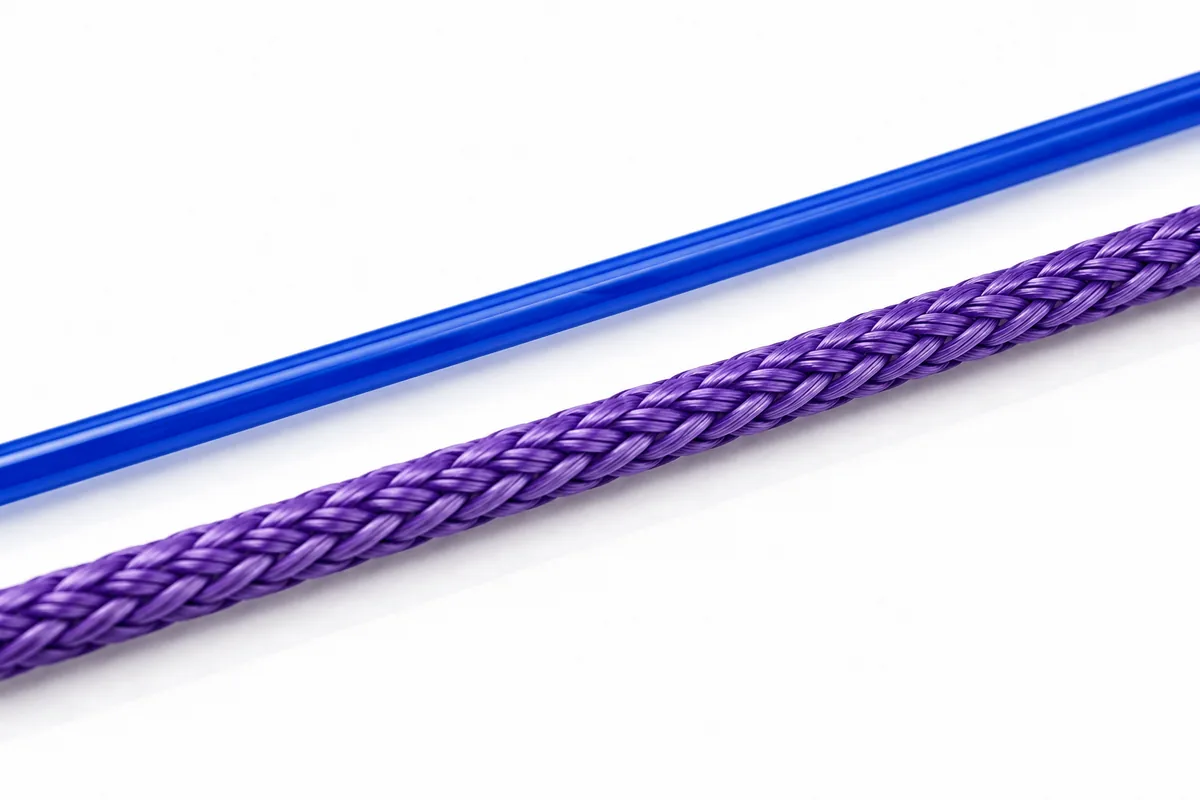
Barbed sutures are a third form: monofilaments with projections formed on the surface that engage tissue along the strand’s length, so the strand’s position is held by the barbs rather than by a knot. They are made in polydioxanone, poliglecaprone and polypropylene.
Monofilaments in general use include polypropylene, nylon, PVDF, PTFE, stainless steel, poliglecaprone and polydioxanone. Braided multifilaments include PGA, polyglactin 910, silk, polyester and UHMWPE; catgut is twisted rather than braided. See the suture materials chart for a side-by-side view.
Natural and synthetic
The third axis is the origin of the raw material. Natural fibres are derived from a living organism — catgut from purified collagen, silk from the silkworm fibre. Synthetic fibres are polymers produced by chemical synthesis, and they make up most of the materials in current use. The axis matters mainly because it tracks the absorption mechanism: the collagen-based material is the enzymatically degraded one.
Coated and uncoated
The fourth axis is the surface. A coating is a thin layer applied over the strand as manufactured, by dipping, brushing, spraying, roll, spin or flow coating. Coating is normally applied to braided rather than monofilament strands, because a braid has the surface texture that a coating addresses and takes a coating more readily.
Coating materials in use include polycaprolactone, calcium stearate, silicone, wax, PTFE and chromium salts. Coatings such as chlorhexidine, triclosan or silver ion may be applied to a suture as a surface coating in addition to the regular coating materials.
Coated materials include PGA, chromic catgut, polyglactin 910, silk, polyester, poliglecaprone and polydioxanone. Uncoated materials include polypropylene, nylon, PVDF, UHMWPE, stainless steel and PTFE.
Size and application
Sutures are also grouped by gauge and by intended application. Gauge is designated on the USP scale with a parallel metric figure; the USP fixes both the diameter range and the tensile-strength requirement at each size, and the European Pharmacopoeia sets an equivalent standard. The suture sizes chart sets out the ranges for collagen and synthetic materials.
Application groupings — general, cardiovascular, orthopaedic, dental, gynaecological, veterinary, cosmetic, ophthalmic — are the loosest of the classifications, because a given material may appear across many of them. What usually changes with the application is not the polymer but the size, the strand length and the needle profile.
Types of suture technique
“Types of sutures” is also used for the ways a suture is placed — the stitch pattern rather than the material. The pattern is chosen for the wound, independently of the material used to sew it.
- Simple interrupted — separate stitches, each tied on its own; secure, and adjustable stitch by stitch.
- Continuous (running) — one strand run along the wound and tied at each end; faster, with tension shared along the line. Both are compared in interrupted and continuous suturing.
- Mattress (vertical or horizontal) — each stitch crosses the wound twice, everting the edges (vertical) or spreading tension (horizontal).
- Subcuticular — a continuous stitch just beneath the skin surface that leaves no stitch marks; commonly placed with an absorbable suture.
- Purse-string — a continuous stitch around a circular opening, drawn tight to close it.
- Knotless (barbed) — a barbed suture that anchors itself without knots, described in knotless closure.
Whatever the pattern, the knot is where a closure most often fails; what makes a surgical knot hold explains why.
Key terminology
- Absorbable
- Broken down in tissue over time. Synthetic absorbables are cleaved by hydrolysis; collagen-based materials are broken down by proteolytic enzymes.
- Non-absorbable
- Not broken down in tissue. Such sutures are either removed after a surface wound has closed or left in place.
- Monofilament
- A strand extruded as a single filament. It has no interstices between filaments and therefore no capillarity.
- Multifilament
- A strand assembled from many fine filaments braided or twisted together. The construction creates interstices, which is why multifilaments are the strands that are coated.
- Barbed
- A monofilament with projections cut or formed on its surface, which engage tissue along the strand's length. Described as knotless because the barbs, not a knot, hold the strand's position.
- Coating
- A surface layer applied over the strand as manufactured, to alter its surface properties. Applied by dipping, spraying, roll, spin or flow coating, or brushing.
- USP
- United States Pharmacopeia. Sets the diameter range and tensile-strength requirement a suture must meet at each gauge. The European Pharmacopoeia (EP) sets a parallel standard.
Technical characteristics
- Classification axes
- Absorption, construction, raw-material origin, coating, gauge, and intended application
- Absorbable material families
- Polyglycolic acid, polyglactin 910, poliglecaprone 25, polydioxanone, catgut
- Non-absorbable material families
- Polypropylene, polyamide (nylon), polyester, PVDF, PTFE, UHMWPE, silk, stainless steel
- Absorption mechanisms
- Hydrolysis (synthetic absorbables); enzymatic breakdown (collagen-based)
- Common coating materials
- Polycaprolactone, calcium stearate, silicone, wax, PTFE, chromium salts
- Sizing
- By USP gauge with a parallel metric designation; see the suture sizes chart
- Strength retention & absorption period
- Stated in the instructions for use supplied with the product — these are product-specific and are not reproduced here.
- Indications
- Stated in the instructions for use. No material is indicated for every tissue type; the IFU specifies the exclusions.
How it compares
| Material | Origin | Construction | Absorption mechanism | Typical uses |
|---|---|---|---|---|
| Polyglycolic acid (PGA) | Synthetic (100% glycolide) | Braided multifilament | Hydrolysis | General soft-tissue closure |
| Polyglactin 910 | Synthetic (glycolide/L-lactide copolymer) | Braided multifilament | Hydrolysis | Soft-tissue approximation, ligation, GI |
| Poliglecaprone 25 | Synthetic (glycolide/caprolactone copolymer) | Monofilament | Hydrolysis | Subcuticular skin, fast-healing soft tissue |
| Polydioxanone | Synthetic (p-dioxanone) | Monofilament | Hydrolysis | Fascia, slow-healing tissue |
| Catgut | Natural (purified collagen) | Twisted | Enzymatic (proteolytic) | Fast-healing soft tissue |
| Polypropylene | Synthetic (polyolefin) | Monofilament | Non-absorbable | Vascular, hernia, skin |
| Polyamide (nylon) | Synthetic (polyamide) | Monofilament or braided | Non-absorbable | Skin closure, microsurgery |
| Polyester | Synthetic (polyethylene terephthalate) | Braided multifilament | Non-absorbable | Cardiac, orthopaedic |
| PVDF | Synthetic (polyvinylidene fluoride) | Monofilament | Non-absorbable | Vascular, cardiovascular |
| PTFE | Synthetic (polytetrafluoroethylene) | Monofilament | Non-absorbable | Vascular, dental |
| UHMWPE | Synthetic (ultra-high-molecular-weight polyethylene) | Braided multifilament | Non-absorbable | Tendon, orthopaedic |
| Silk | Natural (silkworm protein fibre) | Braided multifilament | Non-absorbable | Ligation, securing drains |
| Stainless steel | Synthetic (metal alloy) | Monofilament or multifilament | Non-absorbable | Sternal, orthopaedic |
What clinicians weigh when selecting
The axes are independent
The trade-off is not "absorbable or braided" — a material has a position on each axis at once. Poliglecaprone is absorbable and a monofilament; silk is natural and non-absorbable. Treating the axes as a single scale is what produces the wrong shortlist.
Construction against the field
Braided strands have interstices and capillarity; monofilaments have neither. Whether that is relevant is a judgement about the field — clean, contaminated or infected — rather than about the material on the shelf.
Origin against mechanism
Collagen-based materials are broken down by enzymes, so their behaviour is coupled to the patient's inflammatory response. Synthetic absorbables are cleaved by water. The question is which variable you would rather be exposed to in a given bed.
Coated against uncoated
Coating alters the strand's surface. Because braids are easier to coat and have more surface texture to address, coating tends to follow construction — which means the coated/uncoated axis is not fully independent of the multifilament/monofilament one.
Gauge and application
USP size fixes the strength a strand must meet at that gauge. Application-specific ranges — cardiovascular, ophthalmic, dental — usually differ less in material than in size, length and needle profile.
Regulatory status in your market
Approved indications differ by market. The instructions for use supplied with the product in your country is the governing document.
Frequently asked questions
What are the main types of sutures?
Sutures are divided first into absorbable and non-absorbable. Common absorbable sutures are polyglactin 910, polyglycolic acid, poliglecaprone 25, polydioxanone and catgut; common non-absorbable sutures are polypropylene, nylon, polyester, silk, PTFE, UHMWPE and stainless steel. Across both groups, sutures are also classed by construction (monofilament, braided or barbed), by origin (natural or synthetic) and by whether they are coated.
Are all synthetic sutures absorbable?
No. The axes are independent. Polypropylene, polyester, nylon, PVDF, PTFE and UHMWPE are all synthetic and all non-absorbable; PGA and polydioxanone are synthetic and absorbable.
Which sutures are natural?
Catgut, which is purified collagen, and silk, a protein fibre. Both are natural in origin, but catgut is absorbable and silk is not.
What is a barbed suture?
A monofilament with projections formed on its surface that engage tissue along the strand, so the strand holds its position without a knot. Barbed sutures are made in polydioxanone, poliglecaprone and polypropylene.
Why are some sutures coated and others not?
Coating is normally applied to braided rather than monofilament strands — a braid has surface texture and is more readily coated. Coating materials include polycaprolactone, calcium stearate, silicone, wax, PTFE and chromium salts.
How do I choose between suture types?
Selection is a clinical judgement, and the approved indications and the tissue types a product is not indicated for are stated in its instructions for use. This article describes what the material families are; it does not recommend one.
Instructions for use
The instructions for use supplied with the product is the controlled document for indications, contraindications, strength-retention and absorption data, warnings and precautions. Where this article and the instructions for use differ, the instructions for use govern. Approved indications vary by market.
Medical & regulatory notice
This article is general reference information about suture materials for healthcare professionals. It is not medical advice, not a recommendation for any procedure or patient, and not a substitute for the instructions for use supplied with the product or for clinical judgement. Product availability and approved indications vary by market. Dolphin Sutures manufactures surgical sutures; nothing here should be read as a claim of clinical benefit or of superiority over another material.