

· Dolphin Sutures
Stapling devices: powered, buttressed and increasingly instrumented
Linear, circular and skin staplers have been standard for decades. Powered firing, staple-line reinforcement and sensing in the jaw are what changed.
· Dolphin Sutures
Linear, circular and skin staplers have been standard for decades. Powered firing, staple-line reinforcement and sensing in the jaw are what changed.
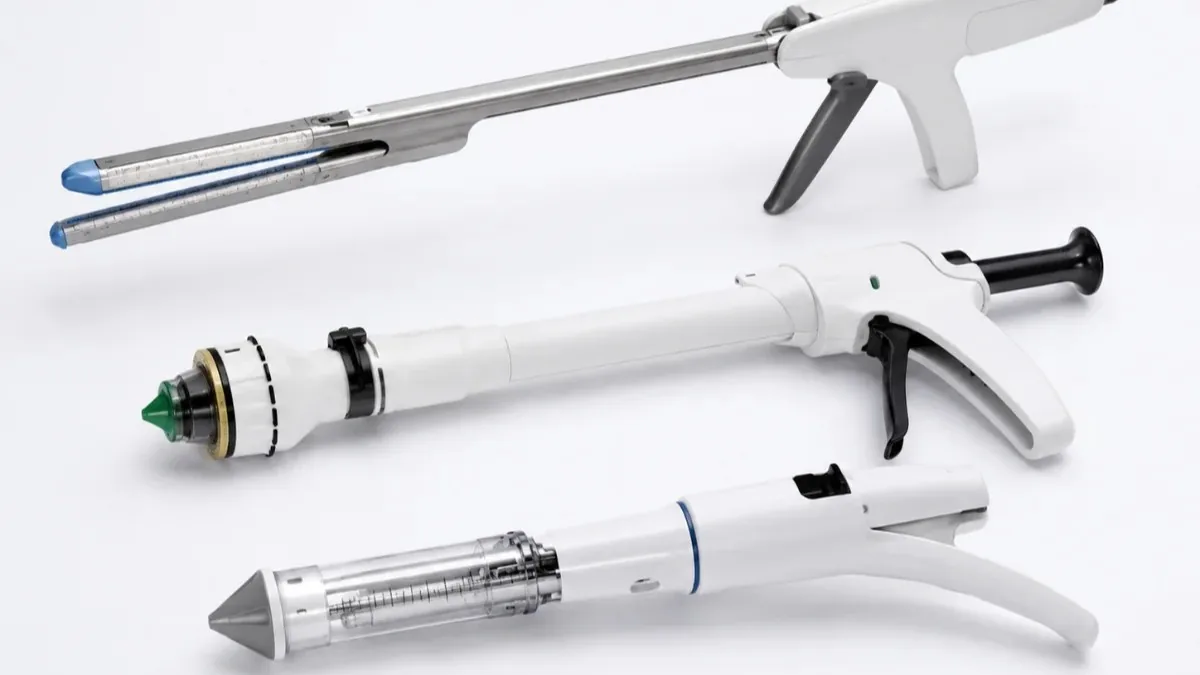
Mechanical closure has been routine for so long that it rarely gets described as technology. A stapler places several rows of staples and, in most configurations, divides tissue between them in a single action — replacing a sequence of hand-sewn steps with one that is faster and more reproducible between operators. That reproducibility, more than speed, is why stapling took over where it did.
Linear staplers place parallel rows of staples in a straight line, with or without cutting between them. They are the workhorses of resection and closure in general, thoracic and colorectal surgery.
Circular staplers place staples in a ring and cut a lumen inside it, forming an end-to-end anastomosis in one action. They are what made low colorectal anastomosis routine.
Skin staplers close the skin from outside with individual staples. Mechanically much simpler, and evaluated on entirely different criteria: speed of closure, consistency of staple formation, and how the staples come out.
The three families share a name and very little else. Conflating them — particularly conflating a skin stapler with an internal stapling device — is one of the more common sources of confusion in this category.
The clearest change of the last decade is the shift from manual to powered firing in internal staplers.
A manual stapler is fired by squeezing a handle, which means the force and the rate of firing come from the surgeon’s hand. Two things follow. The device can move slightly as it fires, and the rate varies between operators and across a long firing. A powered device fires at a controlled rate independent of hand force, which removes both variables.
The argument for it is not effort. It is that tissue behaves differently depending on how quickly it is compressed and how steadily the jaw is held, and controlling those variables makes the result less operator-dependent. Powered devices are heavier and more expensive, which is the trade-off.
The second development is buttressing: a strip of material placed along the staple line so the staples pass through it as they form. Absorbable synthetic strips and biologic materials are both used.
The reasoning is mechanical and specific. A staple bears against tissue at a small area, and in friable or thin tissue that concentration is where a staple line tears. A buttress spreads the load along the line. Whether that translates into fewer clinical failures is discussed procedure by procedure rather than in general, and the honest position is that the mechanical rationale is clearer than the aggregate outcome evidence.
The most interesting current direction is staplers that measure something while they fire.
Tissue thickness determines the appropriate staple height, and getting it wrong in either direction is a problem: too tall and the staple does not close adequately, too short and it crushes. That judgement is conventionally made by the surgeon from feel and appearance. Devices that measure compression or clamping force in the jaw and either report it or adjust to it turn a judgement into a measurement.
This is also where stapling meets the wider instrumentation trend. A device that records what it measured produces a per-firing record, which is data about a procedure that did not previously exist. What that data is used for — feedback in the moment, technique review afterwards, or quality reporting — is not settled, and it is a different question from whether the measurement improves the firing.
Less than the framing suggests. Stapling dominates where the same closure is repeated in a standard configuration and speed and reproducibility matter most. Suturing dominates where the geometry is irregular, the closure is bespoke, or the tissue will not tolerate a fixed staple configuration. A great many procedures use both, in different layers.
The more useful way to see it is that mechanical and sutured closure have divided the work by predictability of geometry, and the boundary moves as stapler configurations proliferate rather than as one displaces the other.
Dolphin Sutures' skin stapler range is described on its product page; indications and firing instructions for any device are stated in its Instructions for Use.
This article summarises developments reported publicly across the medical-device trade press, conference programmes and clinical literature. It is general professional information — not clinical guidance, and not a claim about any Dolphin Sutures product. Device selection, indications and technique rest with the treating surgeon; refer to the Instructions for Use supplied with any device.
Bulk pricing, OEM manufacturing and export documentation — response within one business day.