
 English
 Español
 Français
 Português
 Русский
 العربية
 Deutsch
 Türkçe
 Bahasa Indonesia
 Tiếng Việt
 ไทย
ไทย 简体中文
简体中文
Polybarb · Specialty Sutures
Polypropylene Barbed Sutures
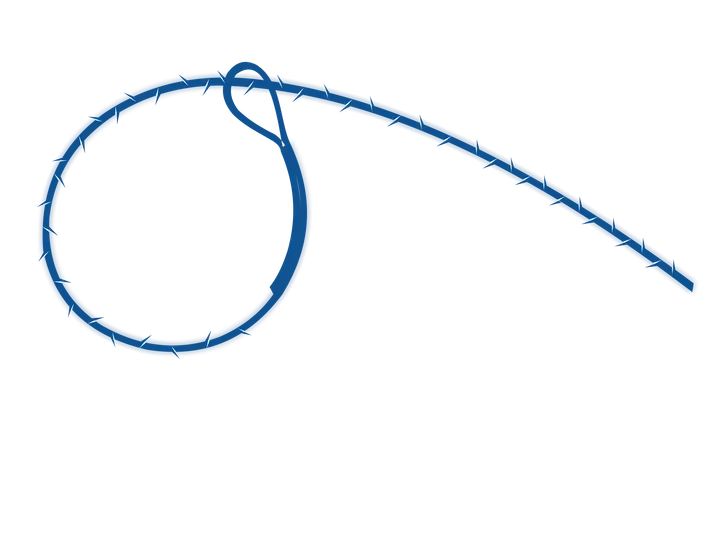
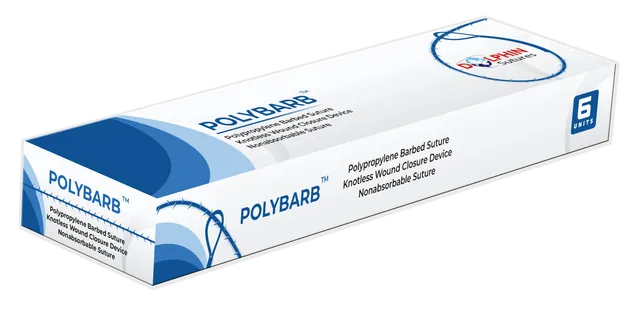
Polybarb is a non-absorbable polypropylene barbed suture from Dolphin Sutures — a knotless wound closure device whose barbs spiral along the whole strand, supplied as a unidirectional loop with one swaged needle.
01
Spiral barb geometry, 72° apart
The barbs are positioned around the strand at 72° from one another and spiral along its entire length, so barbs face every direction rather than lying in a single plane.
02
Knotless by construction
The barbs engage the tissue and hold the line, so no knot is tied. The strand is anchored along its length rather than at a single point.
03
Unidirectional loop, one needle
Supplied as a loop with a single atraumatic needle swaged to the strand — the needle and suture are one continuous unit, with no eye to thread.
04
Non-absorbable polypropylene
Polypropylene has no hydrolysable bond in its backbone, so it is broken down neither by hydrolysis nor by tissue enzymes. The strand remains unless removed.
What Polybarb is
Polybarb is a knotless wound closure device. Two things about it are worth separating, because they are independent: the construction is barbed, and the material is non-absorbable.
The barbs are the visible feature. They are small, formed along the strand, and angled so that it advances freely in one direction through tissue and engages when drawn in the other. That engagement is what holds the line, which is why a barbed suture is described as knotless — the tissue is held by the barbs rather than by a knot the surgeon ties.
The 72° spiral
The barbs are not cut along a single face of the strand. They are set at 72° from one another and spiral around it for its entire length.
The arithmetic is the point: 72° divides 360° exactly five times, so the barbs step around the strand in five positions and then repeat. However the strand sits in the tissue, barbs present on every side of it, and they are distributed along the whole line rather than concentrated anywhere.
Why the material matters more than the barb
The barb determines how the strand anchors. The material determines what happens to it afterwards, and the two questions have different answers.
Polypropylene is a polyolefin: a hydrocarbon backbone with no ester or amide bond in it. Hydrolysis needs a bond that water can cleave, and enzymatic breakdown needs one an enzyme recognises. Polypropylene offers neither, so it is not absorbed — the strand stays as it is unless it is removed.
This is the distinction between Polybarb and Durabarb, which is otherwise its closest relative in the range. Durabarb is polydioxanone, absorbed by hydrolysis. Both are barbed monofilaments; they diverge entirely on what remains afterwards.
Monofilament construction
A monofilament is one continuous strand rather than many fine filaments braided together. It has no interstices between filaments, and therefore no capillarity along its length — a property of braid construction that a monofilament does not have.
It also means there is nothing to coat. A braid is coated because braiding leaves a textured surface; a monofilament’s surface is the material itself, so Polybarb is supplied uncoated.
Presentation
Polybarb is supplied as a unidirectional loop with one atraumatic needle swaged to the strand — needle and suture are a single continuous unit, with no eye to thread. It is offered in sizes 3-0, 2-0, 0 and 1, in loop lengths from 15 cm to 70 cm, on a 1/2 circle taper point needle: 26 mm at 3-0 and 2-0, and 37 mm at 0 and 1. The heavy 37 mm needle is supplied on size 1 and on the longer size-0 loops — the 45 cm and 70 cm — while the 15 cm and 30 cm size-0 loops take the standard 37 mm needle. Boxes contain 6 units.
Sizes, indications and ordering
The instructions for use supplied with the product is the controlled document for approved indications, contraindications, warnings and handling. Approved indications vary by market. The code list on this page gives the configurations offered; contact Dolphin Sutures directly for availability in your market.
Frequently Asked Questions
Bulk pricing, OEM manufacturing and export documentation — response within one business day.
Contact SalesWhat is Polybarb made of?
How does a barbed suture hold without a knot?
What does the 72° spiral barb configuration mean?
Is Polybarb absorbed?
How does Polybarb differ from Durabarb?
What sizes and configurations is Polybarb available in?
What is Polybarb indicated for?
How can distributors obtain documentation and ordering details?
Related products
Polydioxanone Barbed Sutures
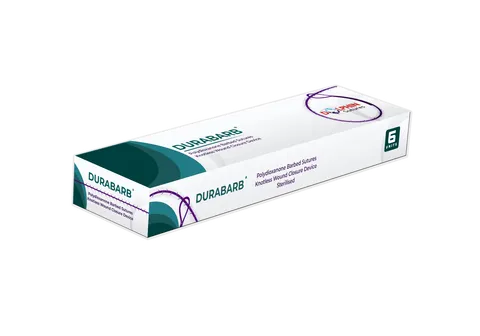
Durabarb Polydioxanone Barbed Sutures are sterile, synthetic absorbable monofilament devices for knotless wound closure, using surface barbs to distribute tension evenly and support continuous tissue approximation during general surgery.
View details →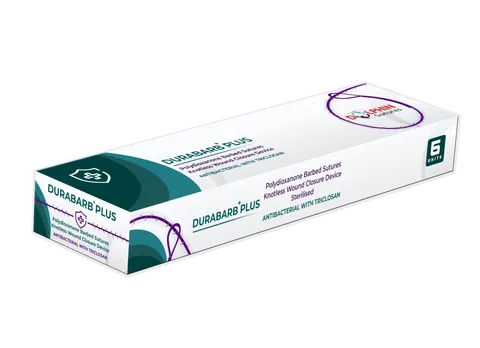
Polydioxanone Antibacterial Barbed Sutures
Durabarb Plus is a monofilament polydioxanone barbed suture with a triclosan coating, engineered for knotless, continuous wound closure and secure tissue approximation across a range of surgical specialties.
View details →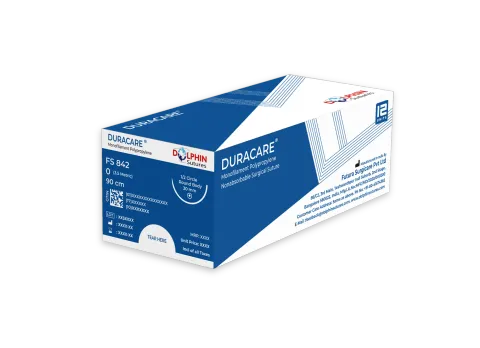
Polypropylene Sutures
Duracare Polypropylene Sutures are synthetic, non-absorbable monofilament sutures that pass smoothly through tissue and provide permanent wound support with minimal tissue reaction, dyed blue for clear identification throughout general and specialty surgical procedures.
View details →Get a quote for Polybarb
Bulk pricing, OEM manufacturing and export documentation — response within one business day.