
 English
 Español
 Français
 Português
 Русский
 العربية
 Deutsch
 Türkçe
 Bahasa Indonesia
 Tiếng Việt
 ไทย
ไทย 简体中文
简体中文
Mesh Pore Size and Weight
Pore size is the dimension of the openings in a knitted surgical mesh. Areal density, usually given in grams per square metre, is the mass of material per unit area — the figure behind the descriptions lightweight and heavyweight. The two are related through the knit but are not the same measurement.
Why it matters
Lightweight and macroporous are used almost interchangeably in conversation, and they are different properties measured in different units. A mesh can be made lighter by using less material or by opening the structure, and those are distinct manufacturing routes with distinct consequences. Separating the two is what lets a clinician read a specification rather than a marketing adjective.
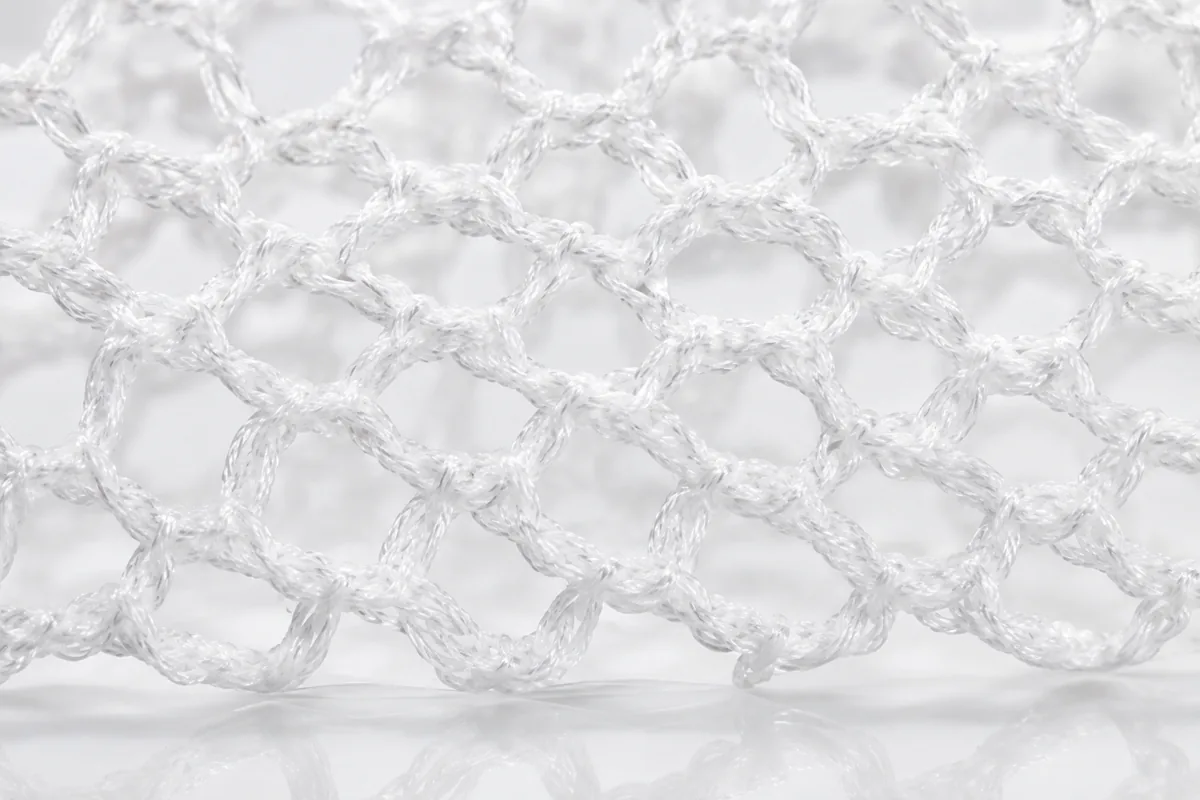
Two measurements, routinely confused
Pore size is a dimension. It describes how large the openings in the knit are, and it is quoted in millimetres or micrometres depending on the product.
Areal density is a mass. It describes how much material there is per unit area, and it is quoted in grams per square metre. This is the figure that sits behind the words lightweight and heavyweight.
These are different quantities in different units, and a mesh can move on one without moving much on the other. That is the single most useful thing to hold onto, because the two words are used almost interchangeably in conversation and the specifications they refer to are not interchangeable at all.
How a mesh is made lighter
There are two routes, and they are not equivalent.
The filament can be made thinner. The knit geometry stays as it was, the pores keep roughly their shape and size, and there is simply less material in each strand — so areal density falls while porosity changes comparatively little.
Or the knit can be opened. The filament stays as it was and the structure is made less dense, so the pores grow and areal density falls with them.
Both produce a lower number in grams per square metre. They do not produce the same sheet, and a specification quoting only areal density does not distinguish between them. This is why pore dimension and areal density are both worth reading, and why a mesh described only as “lightweight” has told you less than it seems to.
Why the terms have no fixed boundary
There is no universally agreed threshold separating lightweight from heavyweight, or macroporous from microporous. They are comparative descriptions that took hold because they were useful in conversation, and they remain useful there.
They are not, however, categories a product can be sorted into unambiguously. The reliable basis for comparison is the product’s own stated figures — pore dimension and areal density — which is why those numbers appear in product documentation and why this article does not attach values to the adjectives.
Strength is a separate matter, and this site does not publish strength figures for mesh in any form. Where a product carries one, it is in the instructions for use supplied with it.
Key terminology
- Pore
- An opening in the knitted structure. Its size is a dimension, quoted in millimetres or micrometres depending on the product.
- Macroporous
- A mesh whose pores are large, in the millimetre range. A relative description rather than a defined threshold with universal agreement behind it.
- Microporous
- A mesh whose openings are substantially smaller. Again relative, and defined per product rather than by a single accepted cut-off.
- Areal density
- Mass per unit area, usually grams per square metre. The measurement behind lightweight and heavyweight.
- Lightweight / heavyweight
- Relative descriptions of areal density. They describe positions on a spectrum, not two defined classes with an agreed boundary.
- Effective porosity
- The proportion of the sheet that is open rather than material. Determined by pore size and by how much material surrounds each pore.
- Filament diameter
- The thickness of the yarn used in the knit. Reducing it lowers areal density without necessarily changing the pore geometry.
Technical characteristics
- Pore size — what it is
- A dimension; the size of the openings in the knit
- Pore size — units
- Millimetres or micrometres, product-specific
- Areal density — what it is
- Mass of material per unit area
- Areal density — units
- Grams per square metre
- Relationship
- Related through the knit, but independently variable — filament diameter and knit geometry can be changed separately
- Lightweight / heavyweight
- Relative terms describing areal density. No universally agreed numerical boundary; read the product specification.
- Product figures
- Pore size and areal density for a given product are stated in its instructions for use and product documentation.
- Strength characteristics
- Stated in the instructions for use. We do not publish strength figures for mesh.
How it compares
| Property | What it measures | Units | Changed in manufacture by |
|---|---|---|---|
| Pore size | Dimension of the openings | Millimetres or micrometres | Geometry of the knit |
| Areal density | Mass of material per unit area | Grams per square metre | Filament diameter and knit density |
| Effective porosity | Proportion of the sheet that is open | Percentage | Both of the above together |
| Filament diameter | Thickness of the yarn | Micrometres | Extrusion |
What clinicians weigh when selecting
Lighter and more open are not the same change
Areal density can be reduced by thinning the filament or by opening the knit. Those are different manufacturing routes reaching a similar number, and the resulting sheets are not equivalent.
The terms are relative
Lightweight and macroporous describe positions on a spectrum, not defined classes. The relevant question is what the specification actually says for the product in hand.
Handling follows from structure
How a sheet drapes and conforms is a consequence of its knit and its areal density. That is a property of the object; what it means for a given repair is a judgement about the repair.
Pore geometry is not only size
A pore has a shape as well as a dimension, and the knit determines both. Quoting a single number describes less than it appears to.
Read the specification, not the adjective
Because there is no universal boundary between lightweight and heavyweight, a product's own stated figures are the only reliable basis for comparison.
The instructions for use govern
Indications, contraindications and any strength specification are stated there and vary by product and market.
Frequently asked questions
What does macroporous mean?
That the openings in the knit are large, in the millimetre range. It is a relative description — there is no single agreed threshold — so the product's stated pore dimension is what to read.
Is lightweight mesh the same as macroporous mesh?
No, though the terms are often used as if they were. Lightweight describes mass per unit area; macroporous describes the size of the openings. A mesh can be made lighter by thinning the filament without changing the pore geometry.
How is mesh weight measured?
As areal density — mass per unit area, usually expressed in grams per square metre. It is a property of the sheet rather than of the piece supplied.
Where is the boundary between lightweight and heavyweight?
There is no universally agreed numerical boundary. They are relative descriptions, which is why the product's own specification is the meaningful figure.
Does a larger pore make the mesh weaker?
We do not publish strength figures or strength comparisons for mesh. Where a product carries a strength specification it is stated in its instructions for use, which is the controlled document.
Which pore size should I use?
That is a clinical judgement about the repair, made by the surgeon. This page describes what the measurements mean; it does not recommend a value.
Instructions for use
The instructions for use supplied with the product is the controlled document for indications, contraindications, warnings, precautions and any pore, density or strength specification. Where this article and the instructions for use differ, the instructions for use govern. Approved indications vary by market.
Medical & regulatory notice
This article is general reference information for healthcare professionals about how surgical mesh is specified. It is not medical advice, not a recommendation for any procedure or patient, and not a substitute for the instructions for use supplied with the product or for clinical judgement. Product availability and approved indications vary by market. Dolphin Sutures manufactures surgical mesh; nothing here should be read as a claim of clinical benefit or of superiority over another product or material.