
 English
 Español
 Français
 Português
 Русский
 العربية
 Deutsch
 Türkçe
 Bahasa Indonesia
 Tiếng Việt
 ไทย
ไทย 简体中文
简体中文
Polyester (PET) Sutures
Polyester is a synthetic non-absorbable suture material, in practice made from polyethylene terephthalate (PET) — a polymer whose chain carries ester linkages. It is braided into a multifilament strand and is commonly coated, typically with silicone, to alter how it passes through tissue.
Why it matters
"Polyester" names a whole class of polymers — anything with an ester group in its main chain — and the class is chemically diverse enough that some of its members are biodegradable and some are not. Suture-grade polyester is specifically polyethylene terephthalate, and knowing that the term has been narrowed is what stops a clinician generalising from the class to the material. The second thing that follows is construction: polyester suture is a braid, and almost everything noticed in the hand — pliability, knot seating, the reason for the coating — follows from the braid rather than from the ester.
What “polyester” means, and what it means here
Polyester is not one material. It is a category — any polymer carrying the ester functional group in its main chain — and the category is broad enough to be genuinely misleading if the term is taken loosely. It includes naturally occurring polyesters, such as the cutin in plant cuticles, and a long list of synthetics built by step-growth polymerisation. Some polyesters are biodegradable. Most synthetic ones are not.
As a suture material, the word has been narrowed to one member: polyethylene terephthalate, PET. Its chain alternates an aromatic terephthalate unit with an ethylene glycol unit, joined by ester bonds, and that aromatic ring is a large part of why the polymer is a robust fibre-former rather than one of the degradable members of the family. Suture-grade polyester is non-absorbable — not appreciably degraded or metabolised in tissue.
The point is worth making because the reasoning does not run from the class to the material. Knowing that a polymer is “a polyester” tells you where to look for its ester bonds; it does not tell you what the body does with it.
The braid, and why it is coated
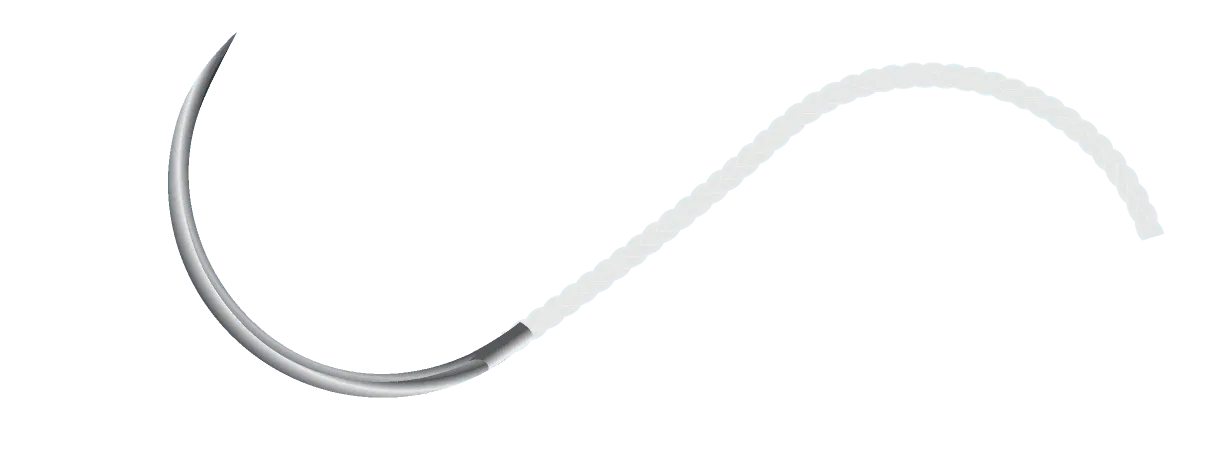
Polyester suture is a braid: many fine filaments braided into one strand. That construction is the origin of the material’s pliability and of the way it seats a knot, and it is what most distinguishes polyester in the hand from a monofilament like polypropylene.
The same construction leaves interstices between the filaments and gives the strand surface texture, which is why a braided suture is coated. On polyester the coating is typically silicone, and it alters how the strand passes through tissue and how a knot ties down. The coating is a response to the construction rather than an addition to it — the reason it exists is the braid.
Capillarity enters the discussion for the same reason. It is a property of multifilament construction, absent from a monofilament by definition, and whether it matters in a given case is a question about the surgical field rather than about the spool on the shelf.
Colour
Polyester is commonly offered in two forms: dyed green and undyed white. Two visually distinct strands are a working aid — they let a surgeon tell one strand or one layer from another during a procedure. Whether that is useful is a question about the operative plan. The dye has no bearing on the material’s behaviour, and colour and gauge availability are product-specific; the product page lists what is offered.
Key terminology
- Polyester
- A category of polymers containing the ester functional group in the main chain. The category includes naturally occurring polyesters and many synthetics; as a suture material the term means polyethylene terephthalate specifically.
- Polyethylene terephthalate (PET)
- The specific polyester used for suture. Its chain alternates an aromatic terephthalate unit with an ethylene glycol unit, joined by ester bonds.
- Step-growth polymerisation
- A polymerisation in which monomers react pairwise into dimers, dimers into tetramers and so on, with the chain building throughout. It is how PET and several other synthetic polyesters are made.
- Multifilament / braided
- A strand built from many fine filaments braided together. Braiding gives pliability and the way a knot seats; it also creates interstices between filaments and gives the strand surface texture.
- Coating
- A surface layer applied to a braid to alter how the strand passes through tissue and how a knot ties down. On polyester suture this is typically silicone.
- Capillarity
- The tendency of a multifilament strand to draw fluid along its length by wicking. It is a consequence of braid construction.
- USP
- United States Pharmacopeia. Sets the gauge and tensile-strength requirements a suture must meet at each size. The European Pharmacopoeia (EP) sets a parallel standard.
Technical characteristics
- Composition
- Polyethylene terephthalate (PET) — a synthetic polyester
- Construction
- Braided multifilament
- Coating
- Commonly silicone; uncoated forms also exist
- Absorption
- Non-absorbable — not appreciably degraded or metabolised in tissue
- Capillarity
- A property of the braid construction
- Colour
- Commonly available dyed green, and undyed white
- Strength retention & duration in tissue
- Stated in the instructions for use supplied with the product — these are product-specific and are not reproduced here.
- Indications
- Stated in the instructions for use. Polyester is not indicated for every tissue type; the IFU specifies the exclusions.
- Standards
- Manufactured to meet the USP and EP requirements for non-absorbable surgical sutures
How it compares
| Material | Origin | Construction | Backbone chemistry |
|---|---|---|---|
| Polyester (PET) | Synthetic (polyethylene terephthalate) | Braided multifilament, commonly coated | Ester bonds in an aromatic chain |
| Polypropylene | Synthetic (linear polyolefin) | Monofilament | Carbon–carbon chain; no hydrolysable bond |
| Polyamide (nylon) | Synthetic (polyamide) | Monofilament and braided forms | Amide bonds; hydrolyse slowly in vivo |
| Silk | Natural (processed protein fibre) | Braided multifilament, coated | Peptide bonds (fibroin protein) |
| Stainless steel | Metallic (316L alloy) | Monofilament and multifilament forms | Not a polymer — metallic |
What clinicians weigh when selecting
Braided construction
Braiding gives a strand pliability and a particular way of seating a knot; it also leaves interstices and surface texture. Both are consequences of the same construction, and which of them is the relevant one is a question about the case.
Coated against uncoated
A silicone coating alters how the strand passes through tissue and how a knot ties down. The trade-off between passage and knot security is a matter of surgeon preference and technique.
Capillarity and the field
Capillarity is a property of multifilament construction. Whether it is a relevant consideration is a judgement about whether the field is clean, contaminated or infected.
Colour as a working aid
Polyester is commonly offered in a dyed and an undyed form. Whether two colours are useful in a given closure — for telling layers or strands apart — is a question about the operative plan, not about the material.
Removal against permanent implantation
The relevant question is whether this strand comes out after healing or stays. The material class does not decide it.
Regulatory status in your market
Approved indications differ by market. The instructions for use supplied with the product in your country is the governing document.
Frequently asked questions
What is polyester suture made of?
Polyethylene terephthalate (PET). "Polyester" is really the name of a whole class of polymers containing an ester group in the main chain, but as a suture material it means PET specifically.
Aren't some polyesters biodegradable?
Yes — the polyester class is chemically diverse, and it includes naturally occurring polyesters and biodegradable synthetics. That is a fact about the class, not about the material. Suture-grade PET is non-absorbable.
Why is polyester suture coated?
A braided strand has surface texture that creates drag as it passes through tissue. A coating alters passage and knot tie-down. On polyester this is typically silicone.
Why is polyester suture green and white?
The dyed and undyed forms are an identification aid — they let a surgeon distinguish strands during a procedure. Colour availability is product-specific.
How long does polyester hold its strength?
That is product-specific and is stated in the instructions for use supplied with the product. We do not publish strength-retention figures outside that document, because the IFU is the controlled source.
What procedures is polyester indicated for?
The approved indications, and the tissue types a product is not indicated for, are stated in its instructions for use, and they vary by market.
Instructions for use
The instructions for use supplied with the product is the controlled document for indications, contraindications, strength-retention data, warnings and precautions. Where this article and the instructions for use differ, the instructions for use govern. Approved indications vary by market.
Medical & regulatory notice
This article is general reference information about a suture material for healthcare professionals. It is not medical advice, not a recommendation for any procedure or patient, and not a substitute for the instructions for use supplied with the product or for clinical judgement. Product availability and approved indications vary by market. Dolphin Sutures manufactures surgical sutures; nothing here should be read as a claim of clinical benefit or of superiority over another material.