
 English
 Español
 Français
 Português
 Русский
 العربية
 Deutsch
 Türkçe
 Bahasa Indonesia
 Tiếng Việt
 ไทย
ไทย 简体中文
简体中文
How to Read a Suture Pack Label
A suture pack label identifies the material, the gauge, the strand length and the needle, together with the reference and lot numbers, the sterilisation method and the use-by date. Read together these specify a single product configuration, which is why two packs of the same material are not necessarily the same item.
Why it matters
A suture is not one product but a configuration — a material, at a gauge, of a length, with a particular needle. The label is where that configuration is stated, and the reference number is the only field that captures all of it at once. Being able to read the label is what makes a catalogue code meaningful rather than an arbitrary string.
A suture is a configuration, not a product
The same material is supplied at many gauges, in several strand lengths, with a range of needles. Each combination is a separate item with its own catalogue number, which is why a request for “polyglactin 3-0” is not yet an order.
The label is where the configuration is written down. Read in order, it gives the material, the gauge, the length of strand in the pack, and the needle — its point geometry, its curvature and its length, usually compressed into a needle code.
Only the reference number carries all of that at once. That is what makes it the field to quote: material, gauge, length and needle each specify one dimension, and the reference specifies the item.
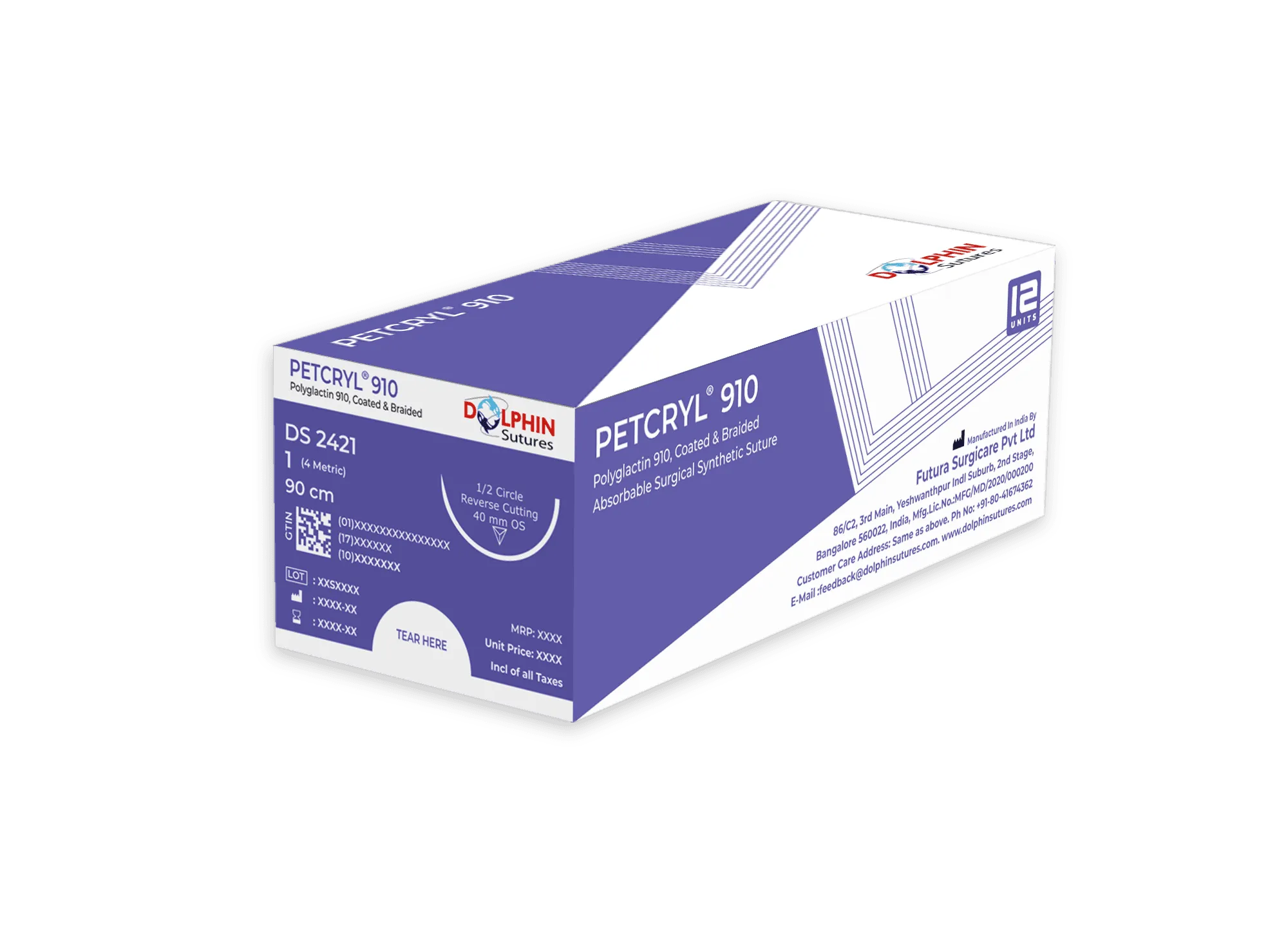
-
Brand and material
PETCRYL® 910 — Polyglactin 910, Coated & Braided
The trade name, then the polymer and construction underneath it. The material is the part that carries across manufacturers; the brand is not.
-
Reference number
DS 2421
The catalogue number for this exact configuration. It is the only field that specifies material, gauge, length and needle at once, which is why it is the field to quote when ordering.
-
Gauge, twice
1 (4 Metric)
The same thickness in two conventions — U.S.P. first, European Pharmacopoeia metric in brackets. The two run in opposite directions, so both are printed.
-
Strand length
90 cm
The length of thread in the pack. Nothing to do with the needle.
-
The needle
1/2 Circle · Reverse Cutting · 40 mm
Curvature, point geometry and needle length, with the needle itself struck alongside at scale so the curve can be checked by eye.
-
GTIN and barcode
(01) … (17) … (10) …
The GS1 data matrix and its human-readable pairs: product number, expiry, batch. This is what a hospital system scans.
-
Lot number
LOT
Identifies the batch this pack came from, not the product. A reference answers "which item"; a lot answers "which run of it" — the field a complaint or a recall works from.
-
Manufacture and expiry
Two dated symbols
The factory symbol dates manufacture, the hourglass dates expiry. Symbols rather than words, so the carton reads the same in every market.
Two numbering conventions in one field
Suture gauge is the field that catches people out, because the notation runs in two directions from a midpoint.
Sizes written with a zero suffix — 2-0, 3-0, 4-0, and on to 6-0 and beyond — get finer as the leading number rises. Sizes written without it — 1, 2, 3 — get thicker as the number rises.
So 6-0 is a fine strand and 2 is a heavy one, and the two are not on the same scale in the intuitive direction. The European Pharmacopoeia metric size usually appears alongside the USP size on the same label, which is often the quicker read precisely because it does not have this reversal in it.
Reference and lot answer different questions
REF identifies what the product is. Two packs with the same reference are the same configuration.
LOT identifies which manufacturing batch a particular pack came from. Two packs with the same reference will usually carry different lot numbers.
The distinction matters when something needs following up. An order or a stock query works from the reference. A traceability enquiry — anything asking about a specific batch — works from the lot. Quoting one where the other is needed is a common source of delay.
What the label does not carry
The label identifies the product and states the sterilisation method, the use-by date and the single-use marking. Symbols used for these are specified by ISO 15223-1, which is why the same hourglass and the same crossed-out figure 2 appear across manufacturers.
What the label does not carry is the clinical detail: indications, contraindications, warnings, precautions, and any strength-retention or absorption data. Those are in the instructions for use supplied with the product, and the label’s function in respect of them is to point you there.
Key terminology
- Gauge (USP size)
- The diameter designation under the United States Pharmacopeia. Sizes run 5 upward for thicker strands and 2-0, 3-0 and so on for progressively finer ones, so a larger number after the zero means a finer strand.
- EP size
- The European Pharmacopoeia designation for the same strand, expressed as a metric gauge. It runs alongside the USP size rather than replacing it.
- REF
- The catalogue or reference number. It identifies the exact configuration — material, gauge, length, needle — as a single code.
- LOT
- The batch code. It identifies the manufacturing batch, which is what a traceability enquiry or a recall works from.
- Use-by date
- The date beyond which the product is not to be used, shown against the hourglass symbol. It applies to the sterile product as packaged.
- Sterilisation symbol
- An indication of the method used — for example ethylene oxide or irradiation. The method is stated on the pack rather than assumed.
- Single-use symbol
- The crossed-out figure 2, indicating the device is not to be reused. Its presence is a statement about the device, not a suggestion.
Technical characteristics
- Material
- The suture material and, where applicable, the brand name under which it is supplied
- Gauge
- USP size, usually with the EP metric size alongside it
- Strand length
- The length of suture in the pack, in centimetres
- Needle
- Point geometry, curvature and needle length, identified by a needle code
- REF
- Catalogue number identifying the complete configuration
- LOT
- Batch code, used for traceability
- Use-by date
- Shown against the hourglass symbol
- Sterilisation
- Method stated on the pack — for example ethylene oxide or irradiation
- Symbols standard
- Symbols used on medical device labels are specified by ISO 15223-1
- Indications
- Not on the label in full — stated in the instructions for use, which the label directs you to
How it compares
| Field | Identifies | Changes between packs of the same material | Used for |
|---|---|---|---|
| Material name | The polymer or origin | No | Selecting the material |
| Gauge (USP / EP) | Strand diameter designation | Yes | Selecting the size |
| Strand length | Length supplied | Yes | Selecting the pack |
| Needle code | Point, curvature and needle length | Yes | Selecting the needle |
| REF | The complete configuration | Yes | Ordering and stock control |
| LOT | The manufacturing batch | Yes | Traceability |
What clinicians weigh when selecting
The reference number is the only complete identifier
Material, gauge, length and needle each describe one dimension of the product. Only the reference number specifies all of them together, which is why it is the field to quote when ordering or querying.
Gauge notation runs in two directions
Sizes with a zero suffix become finer as the leading number rises, while sizes without one become thicker. The relevant question when reading a label quickly is which side of that convention you are on.
Lot is not reference
The reference number identifies what the product is; the lot identifies which batch it came from. A traceability enquiry needs the lot, an order needs the reference.
The sterilisation method is stated
Packs carry the method used rather than leaving it to be assumed, and methods differ between product families.
Package integrity
The sterile barrier is the package. Its condition is part of what the label information presumes, which is why damage instructions appear alongside the date.
The label points to the instructions for use
Indications, contraindications, warnings and any absorption or strength-retention data are in the instructions for use, not on the label. The label directs you there.
Frequently asked questions
Why is 6-0 thinner than 2?
Because the notation runs in two directions from a midpoint. Sizes written with a zero suffix get finer as the leading number rises, so 6-0 is finer than 3-0. Sizes without the suffix get thicker as the number rises, so 2 is thicker than 1.
What is the difference between REF and LOT?
REF is the catalogue number and identifies the exact configuration — material, gauge, length and needle. LOT is the batch code and identifies which manufacturing batch that particular pack came from. Ordering uses REF; traceability uses LOT.
Where do I find the needle type on the pack?
The needle is identified by a code, alongside its curvature and length. What the code denotes for a given range is set out in the product documentation.
Does the label state the absorption period?
No. Absorption and strength-retention data are in the instructions for use supplied with the product, which is the controlled document for them. The label directs you to it.
What does the hourglass symbol mean?
It marks the use-by date. Symbols used on medical device labels are specified by ISO 15223-1, which is why the same symbols appear across manufacturers.
Why do two packs of the same suture have different reference numbers?
Because the reference identifies the whole configuration. A change of gauge, strand length or needle produces a different product and therefore a different reference, even though the material is the same.
Instructions for use
The label identifies the product; the instructions for use supplied with it is the controlled document for indications, contraindications, warnings, precautions and any strength-retention or absorption data. Where this article and the instructions for use differ, the instructions for use govern. Approved indications vary by market.
Medical & regulatory notice
This article is general reference information for healthcare professionals about how suture packaging is labelled. It is not medical advice, not a recommendation for any procedure or patient, and not a substitute for the instructions for use supplied with the product or for clinical judgement. Label layout and the fields present vary by product and by market. Product availability and approved indications vary by market. Dolphin Sutures manufactures surgical sutures; nothing here should be read as a claim of clinical benefit or of superiority over another product.