
 English
 Español
 Français
 Português
 Русский
 العربية
 Deutsch
 Türkçe
 Bahasa Indonesia
 Tiếng Việt
 ไทย
ไทย 简体中文
简体中文
Surgical Hemostats
A surgical hemostat is a material applied to a bleeding surface to help arrest bleeding where clamping, tying or cautery is impractical or insufficient. Some are absorbable and are left in place to be resorbed; others are non-absorbable and work by mechanical occlusion.
Why it matters
Bleeding that a suture or a clip cannot reach — a raw parenchymal surface, a cut bone edge, a diffuse ooze from a dissection plane — needs a different class of device. Hemostats are that class. They are adjuncts: they supplement conventional control rather than replace it, and the difference between the families is mechanical rather than a matter of degree.
Bleeding that cannot be tied
A vessel with a defined end can be closed. It can be ligated with a tie, or occluded with a clip, and the bleeding stops because the lumen is shut. That is the situation most closure devices are designed for.
A great deal of surgical bleeding is not like that. A cut liver or spleen surface, cancellous bone opened by a saw, or the broad face of a dissection plane bleeds from many small channels at once, none of which can be grasped individually. There is nothing to tie. Hemostats exist for that surface.
Two mechanisms, two families
Absorbable hemostats are materials placed on the bleeding surface and left there. They present a physical matrix at the wound face which supports and localises the body’s own clotting process, and the material is then broken down and cleared over time. Oxidised regenerated cellulose is the most widely used example.
Bone wax works on a different principle entirely. It is a pliable, non-absorbable material smeared over the cut surface of bone, and it stops bleeding by physically occluding the open channels — tamponade, not clotting chemistry. It is not resorbed; what is applied stays.
Grouping these two under one heading is a convenience of vocabulary rather than a statement that they are interchangeable. They act on different tissue, by different means, and one disappears while the other does not.
Oxidised regenerated cellulose
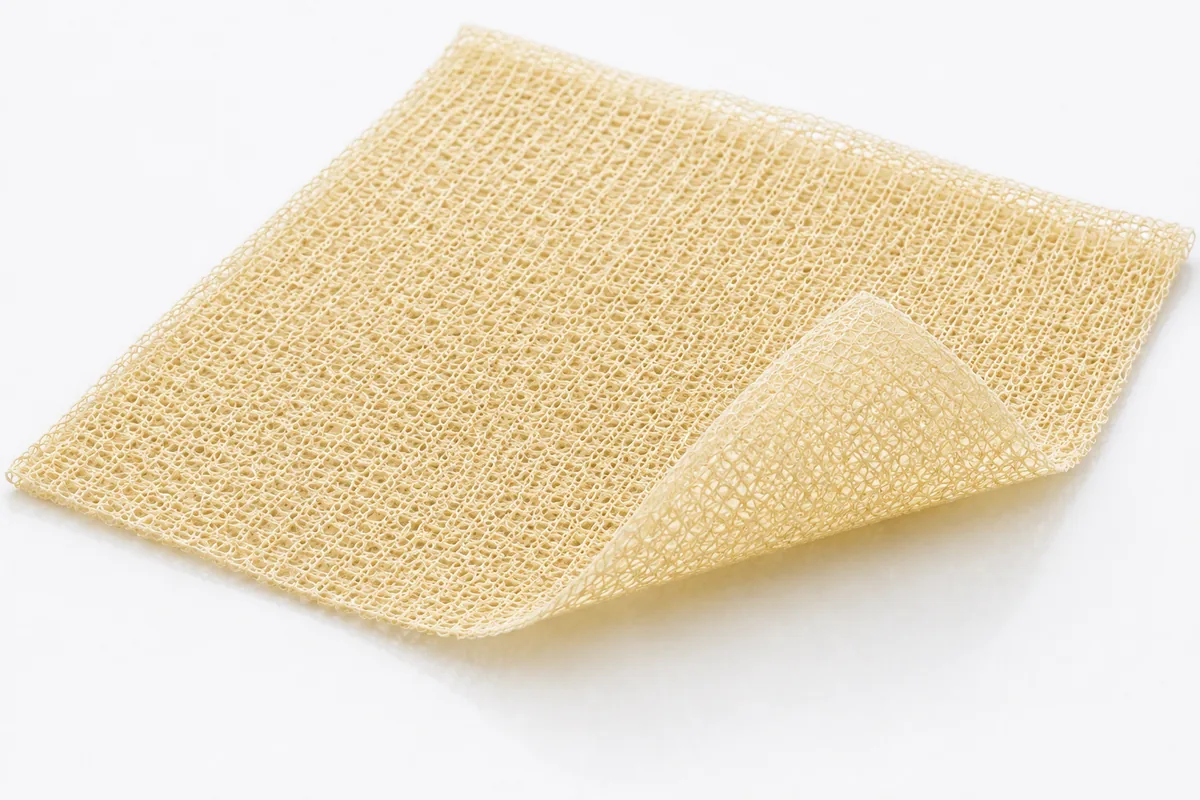
Oxidised regenerated cellulose — ORC — is cellulose that has been regenerated, meaning dissolved and re-spun into a controlled, uniform fibre rather than used in its raw plant form, and then chemically oxidised. Regeneration is what makes the fibre consistent enough to knit; oxidation is what makes it absorbable and gives the material its characteristic low pH.
Because it is knitted into a fabric rather than supplied as a powder or a gel, ORC handles like a textile. It can be cut to the shape of the surface, laid flat, layered or packed into a space, and held with gentle pressure until it takes effect. That handling property is a large part of why the format persists.
Bone wax is not an absorbable hemostat
Bone wax is conventionally a wax base with a softening agent, worked between the fingers until it is malleable and pressed into the bleeding bone surface. Its target tissue is bone, its mechanism is occlusion, and its fate is to remain.
That last point is the one that changes practice. Because the material is not absorbed, how much is used and where it is placed are deliberate decisions rather than incidental ones, and they belong to the operating surgeon working within the instructions for use. A material that stays is a material that has to be justified.
Adjunct, not replacement
Hemostats are described in the literature and in device labelling as adjuncts to conventional methods of haemostasis. A named vessel that can be ligated should be ligated. Reaching for a surface hemostat where a tie or a clip is indicated substitutes a diffuse solution for a definitive one.
What later imaging may show
Absorbable hemostatic material left at a surgical site is not invisible afterwards. Retained material can be apparent on post-operative cross-sectional imaging, and the appearance has been reported in the radiology literature as a recognised mimic of a post-operative collection or abscess.
The practical consequence is documentary rather than clinical: where such a material has been used and left in place, recording that in the operative note gives the radiologist reading a later scan the context to interpret what they are seeing. The material behaves as designed; the risk is one of misreading, and it is avoided with information.
Key terminology
- Haemostasis
- The arrest of bleeding, whether achieved by the body’s own clotting mechanism, by a surgical manoeuvre, or by a device.
- Hemostat
- In this article, a material applied to a bleeding surface. Note that the same word is also used for the clamp instrument — the two senses are unrelated.
- Oxidised regenerated cellulose (ORC)
- Cellulose re-spun into a uniform fibre and then oxidised, which renders it absorbable. Commonly supplied as a knitted fabric.
- Tamponade
- Arrest of bleeding by physical pressure or occlusion of the bleeding channel, rather than by promoting clot formation.
- Absorbable
- Broken down and cleared by the body over time, so that the material does not remain permanently at the site.
- Adjunct
- A device or measure used to supplement conventional treatment, not to replace it. Absorbable hemostats are labelled as adjuncts.
- Bone wax
- A pliable, non-absorbable material applied to a cut bone surface to occlude bleeding channels mechanically.
Technical characteristics
- ORC — material
- Oxidised regenerated cellulose
- ORC — typical form
- Knitted fabric, cut to size at the point of use
- ORC — fate in the body
- Absorbable; broken down and cleared over time
- Bone wax — material
- A wax base with a softening agent
- Bone wax — typical form
- A pliable solid, worked soft and pressed onto bone
- Bone wax — fate in the body
- Non-absorbable; the applied material remains
- Target tissue
- ORC: soft-tissue and parenchymal surfaces. Bone wax: cut bone
- Role
- Adjunct to conventional methods of haemostasis
- Regulatory status
- Regulated as medical devices; classification differs by jurisdiction
How it compares
| Device | What it is applied to | Mechanism | Remains in the body? |
|---|---|---|---|
| Absorbable hemostat (ORC) | A raw or oozing soft-tissue surface | Provides a matrix at which clotting proceeds | No — absorbed over time |
| Bone wax | A cut cancellous bone surface | Mechanical occlusion of bleeding channels | Yes |
| Ligation clip or tie | A discrete vessel with an accessible end | Closes the lumen of the vessel | Clip: yes. Tie: depends on the suture material |
What clinicians weigh when selecting
Is there a vessel to close?
If the bleeding comes from a vessel that can be isolated, it is a ligation problem, not a surface problem. A clip or a tie closes it definitively.
Bone or soft tissue?
The two families are not substitutes for each other. Bone wax is formulated for the cut face of bone; absorbable surface hemostats are used on soft tissue.
Does the material need to disappear?
An absorbable hemostat is cleared over time. A non-absorbable material remains, and the amount left in the wound is therefore a deliberate decision.
What will a later scan show?
Retained absorbable material can be visible on subsequent imaging and can resemble a collection. Recording its use in the operative note prevents the ambiguity.
The instructions for use govern
Quantity, placement, contraindications and any site-specific cautions are stated in each product’s instructions for use. That controlled document, not a reference article, is the operative source.
Frequently asked questions
What is an absorbable hemostat?
A material placed on a bleeding surface that supports the body’s own clotting at that surface and is then broken down and cleared, so nothing permanent is left. Oxidised regenerated cellulose is the most familiar example. It is used as an adjunct where a vessel cannot be tied or clipped.
Is bone wax absorbable?
No. Bone wax is non-absorbable. It works by mechanically occluding the bleeding channels in cut bone, and the material that is applied remains at the site. That is the principal difference between it and an absorbable surface hemostat.
Does oxidised regenerated cellulose dissolve?
It is broken down and cleared by the body rather than dissolving in the everyday sense. How long that takes is a property of the specific product and is stated in its instructions for use, which is the correct source for any figure.
Can a hemostat replace a suture or a clip?
No. Absorbable hemostats are labelled as adjuncts to conventional haemostasis. Where a vessel can be ligated or clipped, that is the definitive control; a surface hemostat addresses bleeding that cannot be handled that way.
Will an absorbable hemostat show up on a scan?
Retained material can be apparent on post-operative imaging, and its appearance is a recognised mimic of a post-operative collection. Noting in the operative record that the material was used and left in place gives the reporting radiologist the context to interpret it correctly.
Is a hemostat the same thing as a haemostat clamp?
No — the word carries two unrelated meanings. A haemostat in the instrument sense is a clamp used to occlude a vessel. A hemostat in the sense used here is a material applied to a bleeding surface.
Instructions for use
This article describes how the families of surgical hemostat work in general terms. It does not state quantities, indications, contraindications or handling instructions for any individual product. Those are given in the instructions for use supplied with the device, which is the controlled document and the only correct source for them.
Medical & regulatory notice
This article is general reference information for healthcare professionals about how a class of device works. It is not a substitute for the instructions for use supplied with any product, it is not clinical guidance, and it does not describe the regulatory status of any particular device in any particular market. Product availability, indications and classification differ between jurisdictions. Clinical decisions about a patient are for the treating clinician.