
 English
 Español
 Français
 Português
 Русский
 العربية
 Deutsch
 Türkçe
 Bahasa Indonesia
 Tiếng Việt
 ไทย
ไทย 简体中文
简体中文
How Surgical Sutures Are Made
Manufacturing a surgical suture is the controlled sequence that turns a raw polymer or natural fibre into a sterile, needle-armed thread of defined size and strength. Almost every clinical property a suture has — how it handles, how it holds a knot, how predictably it is absorbed — is set during that sequence rather than added at the end.
Why it matters
A suture looks like a simple thread, but very little about how it performs is left to chance. The polymer is chosen and then spun, drawn and sometimes braided to give a particular balance of strength and handling; the needle is joined to it as a single continuous piece so the join is no weaker than the strand; and the whole device is packed and sterilised so that what reaches the surgical field behaves exactly as specified. Knowing how a suture is made is the clearest way to see why one suture cannot simply be swapped for another.
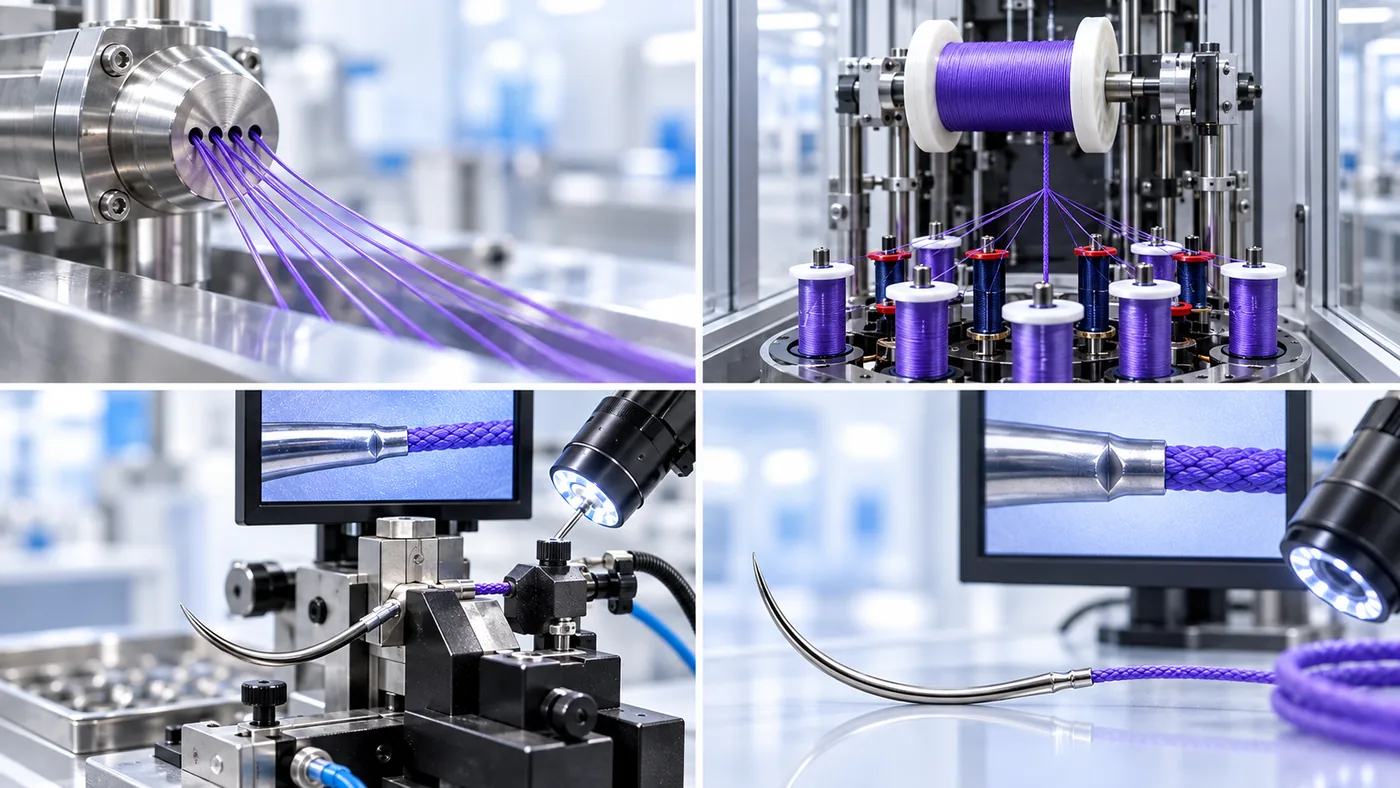
From raw material to filament
Every suture begins as a material chosen for how it will behave in tissue. Synthetic sutures start as a polymer resin — polyglactin, polydioxanone, poliglecaprone, polypropylene, polyamide, polyester and others — selected because its chemistry decides the property that matters most: whether the finished strand will be absorbed by the body or will stay indefinitely.
For a synthetic, the resin is melted and forced through the fine holes of a spinneret, a process called melt-spinning or extrusion. What emerges is a continuous filament far thinner than the eventual strand. Absorbable polymers such as polyglactin and polydioxanone are polyesters that the body breaks down by hydrolysis; non-absorbable polymers such as polypropylene and polyamide are chosen precisely because they resist it.
Natural sutures are made from biological material instead. Catgut is not made from cats: it is purified collagen taken from the submucosal or serosal layer of animal intestine, cleaned, cut into ribbons and spun into a strand. Silk is the fibre a silkworm spins, degummed to remove its natural gum and then braided. These materials are processed rather than extruded, but the goal is the same — a strand of controlled, repeatable dimensions.
Drawing and sizing
A freshly extruded filament is not yet strong. Strength is developed by drawing — stretching the filament under controlled temperature and tension so that the long polymer molecules line up along its length. This orientation is what turns a weak, disordered strand into one that carries load, and it is a large part of why two sutures of the same polymer can differ in performance.
The drawn strand is then calibrated to a precise diameter. Suture sizes follow the United States Pharmacopeia (USP) and European Pharmacopoeia scales, where more zeros mean a finer thread. Diameter is held within tight tolerances because it sets both the size on the label and the minimum strength the strand is required to meet — the two are linked, which is why the exact figures belong to the size standard rather than to any one product.
Monofilament or braided
A strand can be finished as one of two constructions. A monofilament is a single extruded filament, smooth and continuous. A braided (multifilament) suture is many fine filaments interlaced into a single strand. The same polymer can be supplied either way, and the choice is made independently of the material.
The difference is not cosmetic. A braid handles softly and ties easily but has interior spaces between its filaments; a monofilament has none, which changes how each passes through tissue and how its surface behaves. Because construction and material are separate decisions, a specification has to be read on both axes — a fuller account is in monofilament vs braided sutures.
Coating and surface treatment
Braided sutures are usually coated. A thin surface layer reduces the drag of the strand as it is drawn through tissue and lets a knot seat smoothly rather than catching, which is why coating is applied to braids and rarely to monofilaments — a smooth single filament has little for a coating to improve.
Some coatings do more than lubricate. An antibacterial coating adds an agent intended to limit colonisation of the strand itself; how these work is covered in antibacterial coatings for sutures. Catgut is treated differently again: exposing it to chromium salts — chromicisation — slows the rate at which the body breaks it down, which is the whole difference between plain and chromic catgut.
Attaching the needle
Most surgical sutures are supplied already joined to a needle, and how that join is made matters as much as the strand. The needle is drawn from wire, ground to its point and curved to shape, and a fine hole is drilled into its blunt end. The thread is inserted into that hole and the metal is pressed around it — a process called swaging.
The result is a single, continuous device in which the strand runs straight into the needle, with no separate eyelet to thread and no collar wider than the shaft. This is what makes a swaged suture atraumatic: only one thickness of material passes through the tissue, unlike an old eyed needle that drags a doubled thread. The join is engineered so that it is not the weak point, and needle attachment is tested on every batch. The needle itself is chosen for its point and curvature, covered in suture needles and needle points.
Winding, packing and labelling
A finished, needled suture is wound so that it lies without kinks or set, because a strand that reaches the surgeon coiled or bent is harder to handle and can be weakened. It is placed in an inner folder or tray that holds both strand and needle in position, then sealed inside the primary pack — the sterile barrier that keeps the device sterile until it is opened.
For absorbable sutures the pack does a second job. Absorption is driven by moisture, so these are sealed in a foil laminate that keeps water out and protects the strand’s performance, not only its sterility. The outer label is printed with everything needed to identify and use the device — material, size, needle, lot number and expiry — and what each of those symbols means is set out in reading a suture pack label.
Sterilisation and batch release
The sealed device is then sterilised, and which method is used is dictated by the polymer. Absorbable synthetics are commonly sterilised with ethylene oxide, a gas that works at low temperature, because the ionising radiation used in gamma sterilisation can shorten polymer chains and alter how predictably an absorbable strand breaks down. Many non-absorbable materials tolerate either method. The choice, and what it means for the pack, is explained in suture sterilisation and packaging.
Nothing is released on the strength of the process alone. Manufacturing runs under a quality management system — ISO 13485 — and every batch is sampled and tested: the diameter is measured, the strand is pulled to confirm tensile and knot-pull strength, the needle attachment is challenged, sterility is verified and, for a gas process, residual levels are checked against limits. Only a batch that meets every specification is released for sale. How the strength tests are performed is covered in suture strength testing.
Key terminology
- Extrusion (melt-spinning)
- Forcing molten polymer through the fine holes of a spinneret to form a continuous synthetic filament.
- Spinneret
- The die with fine holes through which molten polymer is spun into filaments.
- Drawing
- Stretching a filament under controlled heat and tension so its polymer chains align along the length, which develops tensile strength.
- Monofilament
- A suture made of a single extruded strand, with no internal structure.
- Multifilament (braided)
- A suture built from many fine filaments interlaced into one strand.
- Swaging
- Attaching the thread to the needle by inserting it into a drilled hole in the needle’s end and pressing the metal around it, forming one continuous piece.
- Coating
- A thin surface layer applied to a braided strand to reduce tissue drag and smooth knot tie-down; it may also carry an antibacterial agent.
- Chromicisation
- Treating catgut with chromium salts to slow the rate at which the body absorbs it.
- Batch release
- The step at which a manufactured lot is tested against specification and only then approved for sale.
Technical characteristics
- Synthetic filament formation
- Melt extrusion through a spinneret
- Natural materials
- Purified collagen (catgut); degummed silk fibre
- Strength development
- Controlled drawing (polymer-chain orientation)
- Sizing scales
- USP and European Pharmacopoeia diameter classes
- Constructions
- Monofilament or braided (multifilament)
- Braided-strand finish
- Lubricant and/or antibacterial coating
- Needle attachment
- Swaged — thread set into a drilled needle end, one piece
- Absorbable packaging
- Foil laminate (moisture barrier)
- Sterilisation — absorbable synthetics
- Ethylene oxide
- Sterilisation — many non-absorbables
- Ethylene oxide or gamma irradiation
- Quality system & release
- ISO 13485; per-batch testing before sale
How it compares
| Material family | Starting material | How the strand is formed | Common sterilisation |
|---|---|---|---|
| Absorbable synthetic | Polymer resin (e.g. polyglactin, polydioxanone) | Melt-extruded, then drawn; mono or braided | Ethylene oxide |
| Non-absorbable synthetic | Polymer resin (e.g. polypropylene, polyamide, polyester) | Melt-extruded, then drawn; mono or braided | Ethylene oxide or gamma |
| Catgut (natural, absorbable) | Purified animal collagen | Cut into ribbons and spun; chromicised to slow absorption | Specialised, material-specific |
| Silk (natural, non-absorbable) | Silkworm fibre | Degummed, braided and coated | Ethylene oxide or gamma |
| Stainless steel | Steel alloy | Drawn to wire; monofilament or twisted | Ethylene oxide or gamma |
Why the manufacturing matters clinically
Consistency is built in, not sorted afterwards
Because diameter, strength and absorption are set during manufacturing and confirmed by batch testing, consistency between packs is a property of the process — not something achieved by inspecting out the bad ones.
The needle join is part of the device
A swaged needle is engineered as one piece with the strand and tested on every batch, so needle pull-off is not a variable the user has to manage at the field.
Coating is functional
A coating changes how a braided strand passes through tissue and how a knot seats; it is a designed feature of the suture, which is why coated and uncoated versions of the same material handle differently.
Sterilisation is matched to the polymer
The method is chosen to preserve the material, so an absorbable strand sterilised by the appropriate process behaves as its absorption profile predicts.
The label reflects the manufacturing record
Size, material, needle, lot and expiry on the pack all trace back to a controlled, tested batch; reading them is reading the output of the process.
Frequently asked questions
What are surgical sutures made of?
They are made from either synthetic polymers or natural materials. Synthetic sutures are spun from polymer resins — polyglactin, polydioxanone and poliglecaprone are absorbable, while polypropylene, polyamide (nylon) and polyester are non-absorbable. Natural sutures are made from purified animal collagen (catgut) or from braided silk. The material is chosen mainly for whether the strand should be absorbed by the body or stay permanently.
How is the needle attached to a suture?
By swaging. A fine hole is drilled into the blunt end of the needle, the thread is inserted, and the metal is pressed around it to form a single continuous piece with no separate eyelet. This is what makes a modern suture atraumatic — only one thickness of material follows the needle through tissue — and the attachment is strength-tested on every batch.
How is an absorbable suture made differently from a non-absorbable one?
The difference starts with the polymer: absorbable sutures use polymers the body breaks down by hydrolysis, while non-absorbable ones use polymers that resist it. It continues at sterilisation — absorbable synthetics are usually sterilised with ethylene oxide rather than gamma radiation, because radiation can shorten the polymer chains and change how predictably the strand is absorbed.
Why does drawing make a suture stronger?
Extruded filament has its polymer molecules in no particular order. Drawing stretches the filament so those long molecules line up along its length, and that orientation is what lets the strand carry load. It is a key reason two sutures made from the same polymer can differ in strength and handling.
Are catgut and silk sutures still manufactured?
Yes. Catgut is made from purified collagen taken from animal intestine, spun into a strand and, for chromic catgut, treated with chromium salts to slow absorption. Silk is degummed silkworm fibre that is braided and coated. Both are long-established natural materials still produced alongside modern synthetics.
How is suture quality controlled during manufacturing?
Manufacturing runs under a quality management system such as ISO 13485, and no batch is released on the process alone. Samples from each lot are tested for diameter, tensile and knot-pull strength, needle-attachment strength and sterility, and gas-sterilised product is checked for residuals. Only a lot that meets every specification is released for sale.
Instructions for use
This article describes how surgical sutures are manufactured in general terms. The material, size, needle, sterilisation method and expiry that apply to a particular device are stated on its pack and in its instructions for use, which is the controlled document and the only correct source for them.
Medical & regulatory notice
This article is general reference information for healthcare professionals about how a class of device is made. It is not a substitute for the instructions for use supplied with any product, it is not clinical guidance, and it does not describe the regulatory status of any particular device in any market. Product availability, indications and classification differ between jurisdictions. Clinical decisions about a patient are for the treating clinician.