
 English
 Español
 Français
 Português
 Русский
 العربية
 Deutsch
 Türkçe
 Bahasa Indonesia
 Tiếng Việt
 ไทย
ไทย 简体中文
简体中文
Pillar · surgical mesh
Surgical Mesh
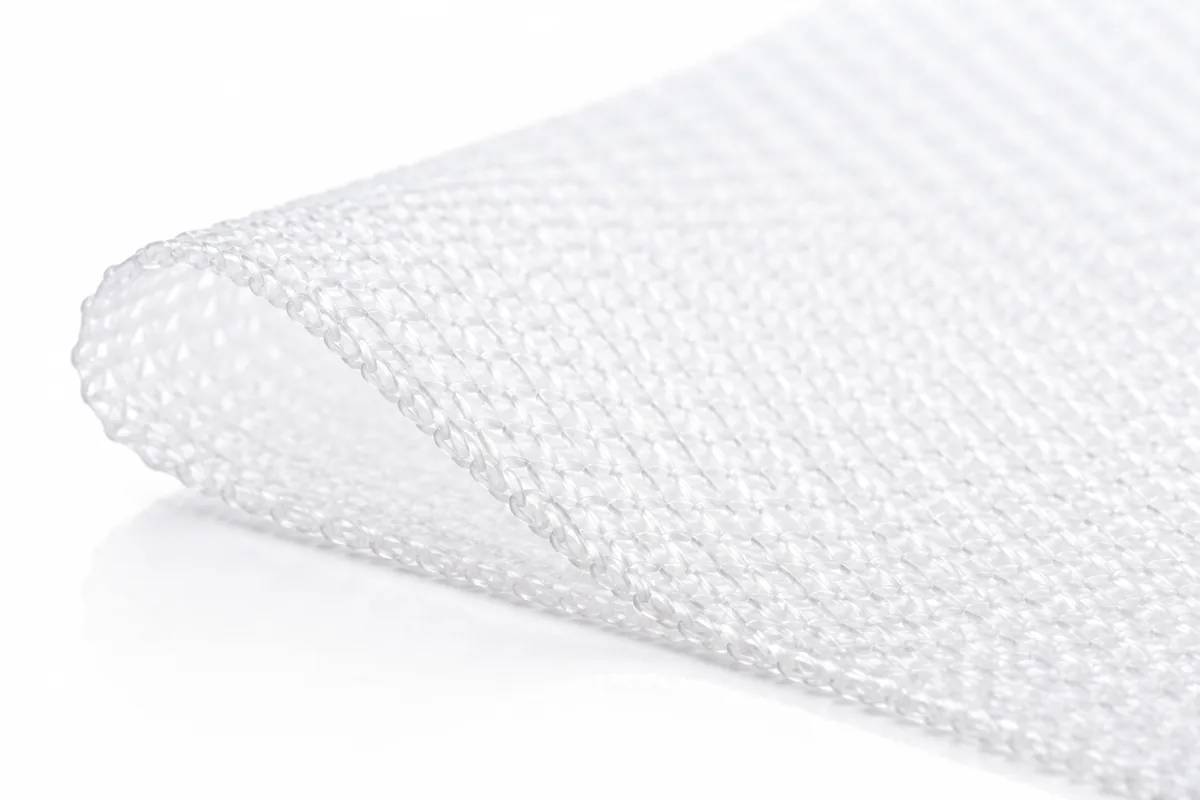
A surgical mesh is a sheet of knitted or composite material used to reinforce soft tissue, most commonly in hernia repair. It is not a suture — a suture holds two edges together along a line, whereas a mesh spreads load across an area. Most are knitted from polypropylene monofilament; some pair that with a second layer on one face, and some combine a permanent material with an absorbable one.
Why it matters
A mesh is described by its construction, and the construction is the whole vocabulary: knitted or composite, monofilament or film, permanent or semi-absorbable, flat or preformed. Those words are what separate one product in a range from another, and reading them is what makes a nine-product catalogue legible rather than a list of brand names.
A mesh is not a suture
Both are wound closure, and they do different mechanical work. A suture holds two edges together along a line. A mesh reinforces tissue across an area — it spreads load over a sheet rather than concentrating it on a strand.
That is why the vocabulary is completely different. A suture is described by its material, its construction and its needle. A mesh is described by how the sheet itself is built.
Knitted, or composite
The first question about any mesh is how many materials it is.
A knitted mesh is one material — usually polypropylene monofilament — knitted into a fabric. The knit is what gives the sheet its open structure and lets it deform. Knit, Knit 3D and Tiolene are knitted meshes.
This figure needs WebGL. A surgical mesh is knitted — columns of monofilament loops, each loop pulled through the loop below it, with regular open pores left between them — not woven. Loops interlocked with loops is what makes it a knit; the pores are the point.
A composite mesh is more than one. Typically a knitted layer is joined to a second layer of a different material on one face, which is why composites are described as dual-sided: the two faces are deliberately not the same, because they meet different tissue. Duolene, Silene, Teflene and Ultralene are dual-sided composites.
Which face is oriented where is a clinical question with a real answer, and that answer lives in the instructions for use rather than here.
Semi-absorbable is not absorbable
This is the distinction most worth getting right, because the word looks like a softer version of “absorbable” and it is not.
A semi-absorbable mesh — Monosolve V2 and Monosolve V2 3D — combines a permanent material with an absorbable one. The absorbable part is broken down by the body. The permanent part is not. So the implant that remains after the absorbable component has gone is not the implant that was placed: it is the permanent fraction of it.
An absorbable mesh would leave nothing. A non-absorbable mesh leaves all of itself. A semi-absorbable mesh leaves some of itself, by design.
Flat, or preformed
Most meshes are supplied as flat sheets and cut to the repair. A 3D or preformed mesh — Knit 3D, Monosolve V2 3D — is shaped to an anatomy instead. That is a fit decision and therefore a clinical one.
What this page does not give you
Pore size, weight, dimensions, orientation and fixation are product-specific, and the instructions for use is the controlled document for all of them. So is every approved indication, and those vary by market.
The range at a glance is in the table above; the specifications for any single mesh are on its own product page.
Key terminology
- Knitted mesh
- A mesh made by knitting a monofilament into a fabric with open interstices. The knit is what gives the sheet its openness and its ability to deform.
- Composite mesh
- A mesh built from more than one material — typically a knitted layer joined to a second layer of a different material on one face.
- Dual-sided
- A composite whose two faces are deliberately different, because the two faces meet different tissue.
- Semi-absorbable
- A composite combining a permanent material with an absorbable one. The absorbable part is broken down; the permanent part is not, so what remains is not what was implanted.
- Monofilament
- A single continuous strand, as opposed to many filaments braided together. Most knitted meshes are knitted from monofilament.
- 3D / preformed
- A mesh shaped to an anatomy rather than supplied flat.
Technical characteristics
- Common material
- Polypropylene monofilament, knitted
- Other materials in the range
- PTFE, polyester and polyethylene appear in the composite constructions
- Constructions
- Knitted (single material) and composite (dual-sided, two materials)
- Absorption
- Most are non-absorbable. Semi-absorbable composites pair a permanent material with an absorbable one.
- Form
- Flat sheets, and preformed 3D shapes
- Pore size, weight, dimensions
- Product-specific. Stated on each product page and in the instructions for use.
- Indications and fixation
- Stated in the instructions for use. Approved indications vary by market.
How it compares
| Mesh | Construction | Absorption |
|---|---|---|
| Knit | Knitted monofilament polypropylene | Non-absorbable |
| Knit 3D | Knitted polypropylene, preformed 3D shape | Non-absorbable |
| Tiolene | Knitted monofilament polypropylene, lightweight | Non-absorbable |
| Duolene | Dual-sided composite, knitted layer plus a second face | Non-absorbable |
| Silene | Dual-sided composite with a polymer face | Non-absorbable |
| Teflene | Dual-sided composite with a knitted layer and a PTFE face | Non-absorbable |
| Ultralene | Dual-sided composite | Non-absorbable |
| Monosolve V2 | Composite | Semi-absorbable |
| Monosolve V2 3D | Composite, preformed 3D shape | Semi-absorbable |
What clinicians weigh when selecting
Construction is the vocabulary
Knitted or composite, monofilament or film, permanent or semi-absorbable, flat or preformed. Every product in the range is a combination of those, and the names only make sense once the axes do.
Two faces, two jobs
A dual-sided composite is dual-sided on purpose — the two faces meet different tissue. Which face goes where, and in which repair, is stated in the instructions for use.
Semi-absorbable means what remains changes
A semi-absorbable composite is not absorbable. Part of it is broken down and part of it stays, so the implant at six months is not the implant at implantation.
Preformed against flat
A 3D mesh is shaped to an anatomy. That is a fit question, and it is a clinical one.
Fixation is a separate decision
How a mesh is held in place — tacks, sutures, or neither — is distinct from which mesh it is. The approved fixation for a product is stated in its instructions for use.
Frequently asked questions
What is a surgical mesh?
A sheet of knitted or composite material used to reinforce soft tissue, most often in hernia repair. Unlike a suture, which holds two edges together along a line, a mesh spreads load across an area.
What is the difference between a knitted mesh and a composite mesh?
A knitted mesh is one material knitted into a fabric. A composite pairs that knitted layer with a second layer of a different material on one face, which is why composites are described as dual-sided.
What does semi-absorbable mean?
The mesh combines a permanent material with an absorbable one. The absorbable portion is broken down by the body and the permanent portion is not — so what remains afterwards is not what was implanted. It is not the same as an absorbable mesh.
Why do some meshes have two different sides?
Because the two faces meet different tissue. Which face is oriented where, and in which repair, is a clinical matter and is stated in the instructions for use.
Which mesh should I use?
That is a clinical judgement, and it is not one this page can make. The approved indications for each product are stated in its instructions for use, and they vary by market.
What pore size and weight does a given mesh have?
Those are product-specific and are stated on each product page and in its instructions for use. They are not reproduced here.
Instructions for use
The instructions for use supplied with the product is the controlled document for dimensions, pore size, weight, orientation, fixation, approved indications, contraindications and warnings. Where this article and the instructions for use differ, the instructions for use govern. Approved indications vary by market.
Medical & regulatory notice
This article is general reference information about surgical mesh for healthcare professionals. It is not medical advice, not a recommendation for any procedure or patient, and not a substitute for the instructions for use supplied with the product or for clinical judgement. Product availability and approved indications vary by market. Futura Surgicare manufactures surgical mesh; nothing here should be read as a claim of clinical benefit or of superiority over another mesh or material.