
 English
 Español
 Français
 Português
 Русский
 العربية
 Deutsch
 Türkçe
 Bahasa Indonesia
 Tiếng Việt
 ไทย
ไทย 简体中文
简体中文
Mesh Construction — Knitted, Composite and Dual-Sided
Surgical mesh construction describes how the implant is built: knitted from a monofilament polymer into an open textile, blended with an absorbable component so part of the implant is resorbed, or assembled as a composite with a different material presented on each face.
Why it matters
Mesh is often discussed as though it were one product with a range of sizes. It is not. A knitted monofilament sheet, a semi-absorbable blend and a dual-sided composite are structurally different implants, and the difference determines what remains in the body, what each face presents to the tissue it contacts, and whether the mesh has an orientation at all. Construction is the first thing to establish, before any figure in the instructions for use can be read in context.
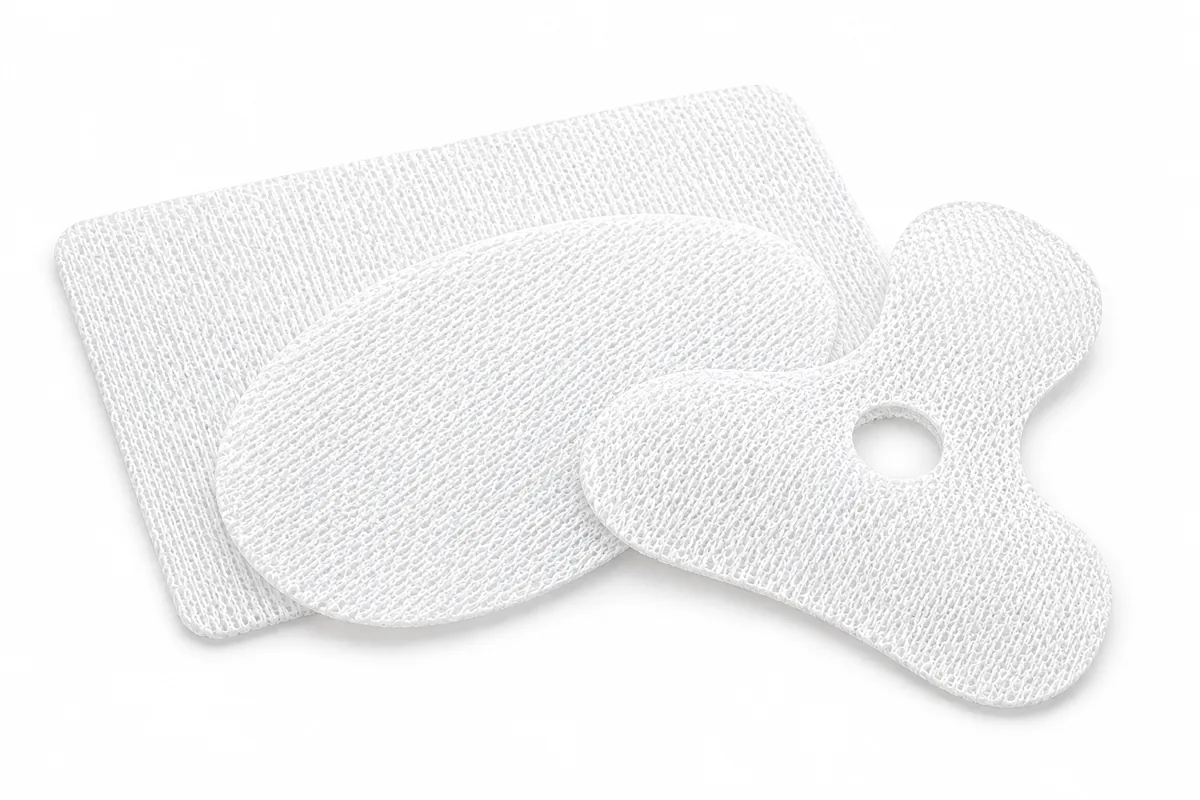
Knitted, not woven
The meshes in general soft-tissue use are knitted: the yarn is interlooped rather than interlaced at right angles as it would be in a weave. Knitting is what gives the sheet its openness and the way it drapes, and it is the reason a mesh can be described by pore and by areal density at all — a knit has a repeating structure with space in it.
Where the yarn is a monofilament, the strand is a single extrusion rather than a bundle. There are no interstices inside the yarn itself; the openness of the sheet comes entirely from the knit structure.
Three families, and what each leaves behind
A knitted polypropylene mesh is permanent. The whole implant stays. Its two faces are alike, so it has no orientation.
A semi-absorbable construction combines a permanent polymer with an absorbable one. The absorbable component is resorbed and the permanent fraction remains, which means the implant at twelve months is not the implant that was placed. What remains, and over what period, is a product specification stated in the instructions for use.
A dual-sided composite presents a different material on each face. This is the construction that most often causes confusion, because it makes the implant asymmetrical: it has a defined orientation, and it is not a sheet that can be placed either way up. Which face is intended toward which tissue is stated in the product’s instructions for use, and that document is the only correct source for it.
A preformed 3D mesh is manufactured to an anatomical shape rather than supplied flat. That is a difference in what arrives on the field, and it applies on top of whichever of the above constructions the mesh uses.
Why this article does not quote strength
Mesh discussions drift toward strength figures quickly, and this site does not publish them — not a number, not a range, not a descriptive substitute for one. Where a product carries a strength specification it belongs in the controlled document supplied with it.
What can be described honestly is construction: what the mesh is made from, how it is built, whether part of it is resorbed, and whether it has an orientation. Those are properties of the object. They are also, in practice, the things a clinician needs settled before any figure in the instructions for use means anything.
Key terminology
- Knitted
- Built by interlooping yarn into a textile, as distinct from woven or non-woven. Knitting gives the sheet its openness and the way it drapes.
- Monofilament
- A single extruded strand rather than a bundle of filaments. A monofilament knit has no interstices within the yarn itself.
- Composite
- A mesh assembled from more than one material, typically presenting a different material on each face.
- Dual-sided
- A composite in which the two faces are deliberately different, so the implant has an orientation. Which face is intended toward which tissue is stated in the instructions for use.
- Semi-absorbable
- A construction combining a permanent polymer with an absorbable one, so part of the implant is resorbed and part remains.
- Preformed (3D)
- A mesh manufactured to an anatomical shape rather than supplied flat, so it is not required to be shaped at the point of use.
- Areal density
- Mass per unit area of the mesh, usually given in grams per square metre. It is the figure behind the terms lightweight and heavyweight.
Technical characteristics
- Knitted polypropylene
- Monofilament polypropylene interlooped into an open sheet; permanent
- Semi-absorbable composite
- Permanent polymer combined with an absorbable component; part of the implant is resorbed
- Dual-sided composite
- Two different materials presented on the two faces; the implant has an orientation
- Preformed 3D
- Supplied in an anatomical shape rather than flat
- Orientation
- Dual-sided constructions have a defined orientation. Which face goes where is stated in the instructions for use.
- Pore and areal density
- Product-specific. See the article on mesh pore size and weight for what these terms describe.
- Strength characteristics
- Stated in the instructions for use supplied with the product. We do not publish strength figures for mesh.
- Indications
- Stated in the instructions for use. Approved indications and contraindications vary by product and market.
How it compares
| Construction | Materials | What remains | Orientation |
|---|---|---|---|
| Knitted monofilament | Polypropylene | The whole implant | None — both faces alike |
| Lightweight knitted monofilament | Polypropylene, lower areal density | The whole implant | None — both faces alike |
| Semi-absorbable composite | Permanent polymer with an absorbable component | The permanent fraction | Product-specific |
| Dual-sided composite | A different material on each face | Product-specific | Defined — stated in the instructions for use |
| Preformed 3D | As the underlying construction | As the underlying construction | Defined by the anatomical shape |
What clinicians weigh when selecting
What remains in the long term
A permanent knit leaves the whole implant in place; a semi-absorbable construction leaves only its permanent fraction. The relevant question is what the surgeon intends to remain, and that is answered against the product's instructions for use.
A composite has an orientation
Because the two faces of a dual-sided mesh are different materials, the implant is not symmetrical and cannot be placed either way up. Which face is intended toward which tissue is specified in the instructions for use and nowhere else.
Openness of the knit, and areal density
How open the knit is and how much material per unit area are separate descriptors that are often conflated. Both are product specifications.
Preformed against flat
A preformed mesh arrives in an anatomical shape; a flat sheet does not. This is a difference in what is supplied, and the trade-off between a fixed shape and a shapeable sheet is a judgement about the case.
Fixation is a separate decision
How a mesh is held in position is distinct from how it is constructed. See the article on mesh fixation.
The instructions for use govern
Indications, contraindications, orientation, warnings and any strength specification are stated there, and they vary by product and by market.
Frequently asked questions
What is a dual-sided mesh?
A composite that presents a different material on each of its two faces, so the implant has a defined orientation. Which face is intended toward which tissue is stated in the product's instructions for use.
Does it matter which way up a composite mesh is placed?
Yes — a dual-sided construction is not symmetrical, which is the point of building it that way. The orientation is specified in the instructions for use supplied with the product.
What does semi-absorbable mean?
That the implant combines a permanent polymer with an absorbable one. The absorbable component is resorbed and the permanent fraction remains. What remains, and over what period, is stated in the instructions for use.
What is a 3D mesh?
One manufactured to an anatomical shape rather than supplied as a flat sheet, so it does not need to be shaped at the point of use.
How strong is the mesh?
We do not publish strength figures for mesh on this site. Where a product has a strength specification, it is stated in the instructions for use supplied with that product, which is the controlled document.
Is knitted the same as woven?
No. Knitting interloops the yarn; weaving interlaces it at right angles. The meshes described here are knitted, and the construction is part of why the sheet behaves as it does.
Instructions for use
The instructions for use supplied with the product is the controlled document for indications, contraindications, orientation, warnings, precautions and any strength or absorption specification. Where this article and the instructions for use differ, the instructions for use govern. Approved indications vary by market.
Medical & regulatory notice
This article is general reference information for healthcare professionals about how surgical mesh is constructed. It is not medical advice, not a recommendation for any procedure or patient, and not a substitute for the instructions for use supplied with the product or for clinical judgement. Product availability and approved indications vary by market. Dolphin Sutures manufactures surgical mesh; nothing here should be read as a claim of clinical benefit or of superiority over another product or material.