
 English
 Español
 Français
 Português
 Русский
 العربية
 Deutsch
 Türkçe
 Bahasa Indonesia
 Tiếng Việt
 ไทย
ไทย 简体中文
简体中文
Needle Points: Taper, Cutting, Reverse Cutting and Blunt
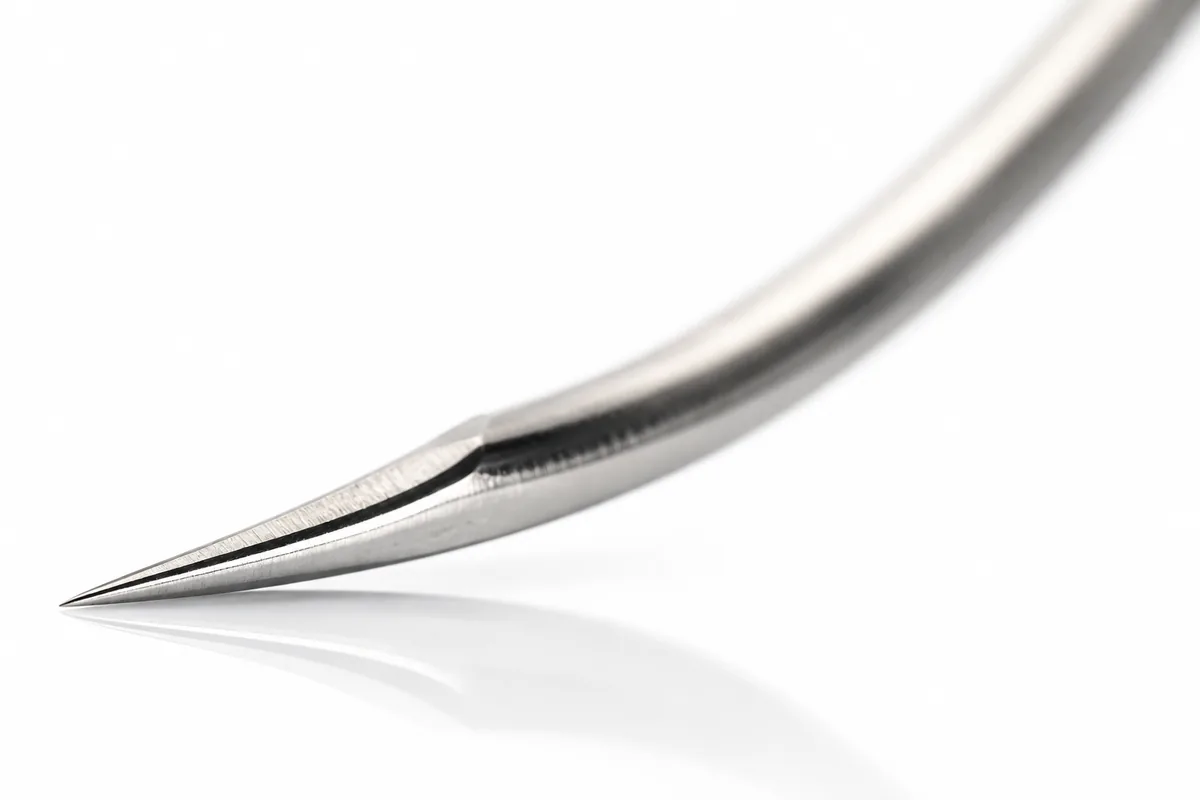
A needle point is the tip geometry of a surgical needle, and it determines how the needle gets through tissue. There are two mechanisms. Round taper and blunt points spread tissue apart; triangular cutting and reverse cutting points divide it with an edge.
Why it matters
Two of the four point geometries cut and two do not, and the two that cut differ only in where the edge sits relative to the needle's curve. That is a small difference to state and a real one in what the needle does as it passes, because the edge sweeps either the inside of the arc or the outside of it. Reading a point specification precisely is what lets a clinician tell the two apart — and it is a question about the needle, not about the strand attached to it.
The cross-section is the point
A point is usually pictured as a tip — the last fraction of a millimetre of steel. The geometry that actually decides anything extends back from that tip along the point section, and the way to see it is to imagine cutting the needle straight across and looking at the face.
There are two answers to what you would see. Round, or triangular.
A round cross-section has no edge anywhere on its circumference. Whatever such a needle does to tissue it does by displacement: the steel occupies space, and the tissue moves aside to accommodate it. Both round geometries work this way and they differ only at the very tip — a taper point narrows progressively to a point, a blunt point ends in a rounded tip.
A triangular cross-section has three faces, and where two faces meet there is an edge running along the needle’s length. An edge presents a much smaller contact area than a curved surface does, so the load is concentrated along a line rather than distributed around an arc of the circumference, and the tissue divides along it instead of moving aside. That is what cutting means mechanically — not sharpness in the abstract, but whether the cross-section has an edge on it at all.
So the four geometries are two families of two: two round and two triangular, two that spread and two that cut.
Why the edge position separates cutting from reverse cutting
Once the cross-section is triangular, a second question appears that never arises for a round one. How is the triangle oriented?
A curved needle traces an arc, and an arc has an inside and an outside — a concave side facing the centre of the circle it belongs to, and a convex side facing away from it. Rotate the triangular cross-section about the needle’s long axis, and the edge that leads the cut moves from one side to the other.
On a conventional cutting needle the edge lies on the concave side: the inside of the curve, facing the wound. On a reverse cutting needle the same triangular cross-section is oriented the opposite way, so the edge lies on the convex side, facing away from the wound.
That is the entire distinction. The two are not different degrees of sharpness and not different classes of needle — they are one geometry described in two orientations, and the names encode nothing except which side of the arc the edge sweeps. It is also why the pair is so easy to state backwards, which is the practical reason to be precise about it.
Which of the two belongs in which tissue is a clinical judgement, and the approved combinations for a given product are stated in its instructions for use.
How far back the edge runs: taper cut, trocar and spatula
“Spread or cut” is the first question, but it is not the only one. A second question separates several geometries that all answer “cut”: how much of the needle carries an edge.
On a conventional or reverse cutting needle the triangular section runs back from the tip along part of the body, so the needle cuts for as long as that section is in the tissue. A taper cut confines the edges to the point: the tip is a small cutting triangle and the shaft immediately behind it is round, exactly like a taper. Set the interactive point figure on /suture-needles/ to Taper cut and turn it — the magnified slice is taken at the tip rather than mid-shaft, because that is the only station where the section is triangular at all. A trocar point is built on the same idea in a heavier gauge. Manufacturers do not use these two names identically, so a code and its documentation are more reliable than the label alone.
A spatula, or side-cutting, geometry changes the question rather than answering it. It is neither round nor triangular but trapezoidal: flat across its top and bottom faces, with the cutting edges on the sides. Every other geometry here is described by where its edge sits relative to the curve — concave or convex. A spatula puts the edges on neither of those faces, so it is shaped to pass within the plane of a tissue layer rather than across it. Set that same figure to Spatula to see the flat section: it is the one profile in the set that is wider than it is thick.
What a point is not
Two things a point specification is regularly read as saying, and does not say.
It does not describe the strand. The point is a specification of the steel. The same reverse cutting geometry is supplied across absorbable and non-absorbable materials, braided and monofilament alike, and the same material is offered on several different points. A needle described as “3/8 circle, reverse cutting” tells you nothing about whether the suture is absorbed, or how. The needle is selected against the tissue it must pass through; the material is selected on its own grounds. Two decisions, taken separately, arriving in one packet.
It does not describe the body. The point is the tip geometry. The body is the section behind it, and it is the length a needle holder grips. They are specified separately and a product code carries both, which is why needles are commonly described in pairs — a body and a point. The two answer different questions: one is about how the needle enters tissue, the other about how it is held and turned.
For the rest of the needle — swaging and the annealed bore, curvature, and the two stainless steel families — see Suture Needles.
Key terminology
- Point
- The needle's tip geometry. It determines how the needle parts tissue: by spreading it or by cutting it. It is a specification of the needle, stated separately from the suture material.
- Cross-section
- The shape seen if the needle were cut straight across at the point section. Round or triangular — this single property is what the whole point taxonomy rests on.
- Cutting edge
- An edge running along the needle where two faces of a triangular cross-section meet. A round cross-section has none anywhere on its circumference.
- Taper
- A progressive narrowing toward the tip. A taper point is round in cross-section and narrows to a point, so it has no cutting edge at any stage.
- Concave and convex sides
- The inside and the outside of a curved needle's arc. The concave side faces the wound and the convex side faces away from it, which is the reference frame the cutting geometries are described in.
- Body
- The section of the needle behind the point, and the part a needle holder grips. It is specified separately from the point and answers a different question.
- Taper cut
- A round, tapering body that ends in a small cutting tip. The cutting edges are confined to the point; the shaft behind it is round, as on a taper point.
- Trocar point
- A round body ending in a cutting tip, made in a heavier gauge. Like a taper cut, its edges are confined to the point rather than running back along the body; usage of the two names varies between manufacturers.
- Spatula (side-cutting)
- A geometry that is flat on its top and bottom faces with the cutting edges on the sides, giving a trapezoidal rather than round or triangular cross-section.
Technical characteristics
- Taper point
- Round in cross-section, narrowing to a tip. Spreads tissue apart without cutting it.
- Cutting point
- Triangular in cross-section, with the cutting edge on the concave (inner) side of the curve, facing the wound.
- Reverse cutting point
- Triangular in cross-section, with the cutting edge on the convex (outer) side of the curve, facing away from the wound.
- Blunt point
- Round in cross-section with a rounded tip. Parts friable tissue without a sharp tip.
- What the point is selected against
- The tissue the needle must pass through, rather than the suture material attached to it.
- Point and body
- Separately specified. The point is the tip geometry; the body is the section the needle holder grips.
- Which point a given code carries
- Stated per product code. The ordering table on each product page gives the point and length supplied against every code.
- Which point suits a given tissue
- A clinical judgement. The approved needle and suture combinations are stated in the instructions for use.
How it compares
| Point | Cross-section | How it passes | Where the edge sits |
|---|---|---|---|
| Taper point | Round, narrowing to a tip | Spreads tissue apart | No cutting edge |
| Taper cut | Round along the shaft, triangular at the tip | The tip cuts; the shaft behind it spreads | Confined to the tip, on the convex side |
| Trocar point | Round body ending in a cutting tip, in a heavier gauge | The tip cuts; the shaft behind it spreads | Confined to the tip |
| Cutting | Triangular | Cuts | On the concave side of the curve, facing the wound |
| Reverse cutting | Triangular | Cuts | On the convex side of the curve, facing away from the wound |
| Spatula (side-cutting) | Trapezoidal — flat top and bottom faces | Passes within the plane of a tissue layer rather than across it | On the two sides, not on the curve's faces |
| Blunt | Round, with a rounded tip | Parts friable tissue without a sharp tip | No cutting edge |
What clinicians weigh when selecting
Spreading against cutting
The first thing a point geometry settles is whether the needle parts tissue or divides it. That is a binary, and it is answered before any finer distinction between the two cutting geometries becomes relevant at all.
Where the edge sits
Conventional cutting and reverse cutting are the same triangular geometry in two orientations. The question is which side of the arc the edge sweeps — the inside or the outside — and that is a question about the path the needle takes.
The point is not the material
A point geometry is a specification of the steel half of the device. What the needle must pass through and what becomes of the strand afterwards are separate questions, weighed on separate grounds and answered in different documents.
The point against the body
One describes the tip, the other the section held in the needle holder. A product code states both, and reading one for the other is a common source of confusion because the two answer different questions.
Tissue is the variable
Which geometry belongs in which tissue is a judgement about the case in front of the surgeon. It is not a property of the needle, and the approved combinations for a given product are stated in its instructions for use.
Point, curvature and length are independent
Settling one does not settle the others — they are three separate axes of the same specification. Each product code states all three, which is where the pairing for a particular suture is found.
Frequently asked questions
What is the difference between a cutting and a reverse cutting needle?
Where the cutting edge sits. Both have a triangular cross-section and both cut rather than spread. On a conventional cutting needle the edge is on the concave side of the curve — the inside of the arc, facing the wound. On a reverse cutting needle it is on the convex side, facing away from the wound. Same geometry, opposite orientation.
What does a taper point do?
It is round in cross-section and narrows to a tip, so it spreads tissue apart as it passes rather than cutting it. There is no cutting edge anywhere on it.
How is a blunt point different from a taper point?
Both are round in cross-section and neither has a cutting edge. They differ at the tip — a taper point narrows to a point, while a blunt point ends in a rounded tip and parts friable tissue without a sharp tip.
Which point should I use for a given tissue?
That is a clinical judgement about the tissue in front of you, not a question this page can answer. The approved needle and suture combinations for a product are stated in its instructions for use, and each product page lists the point geometry supplied against every code.
Does the point tell me anything about the suture material?
No. The point is a specification of the needle, and the same geometry is supplied across many materials. Whether the strand is absorbable or non-absorbable, braided or monofilament, is a separate question answered on the product page and in the instructions for use.
Is the point the same thing as the needle body?
No. The point is the tip geometry; the body is the section behind it, and it is the part the needle holder grips. They are specified separately, and a product code carries both.
Instructions for use
The point geometry supplied with a given product, and the approved needle and suture combinations, are stated in the instructions for use supplied with it and in that product's ordering table. The instructions for use is the controlled document, and where this article and it differ, it governs. Approved indications vary by market.
Medical & regulatory notice
This article is general reference information about surgical needle point geometry for healthcare professionals. It is not medical advice, not a recommendation of any point geometry for any tissue, procedure or patient, and not a substitute for the instructions for use supplied with the product or for clinical judgement. Product availability and approved indications vary by market. Nothing here should be read as a claim of clinical benefit or of superiority over another needle or material.