
 English
 Español
 Français
 Português
 Русский
 العربية
 Deutsch
 Türkçe
 Bahasa Indonesia
 Tiếng Việt
 ไทย
ไทย 简体中文
简体中文
PTFE Sutures
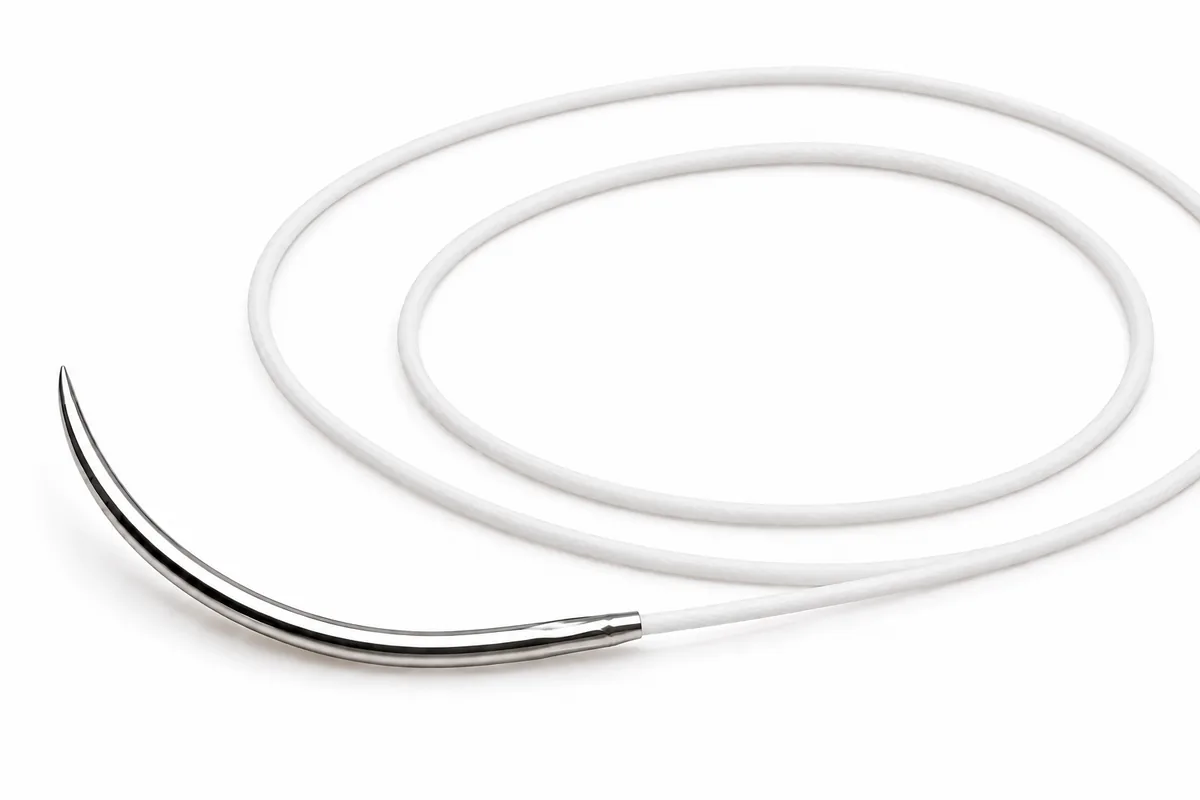
Polytetrafluoroethylene (PTFE) is a synthetic non-absorbable suture material made from 100% high-density polytetrafluoroethylene, a fluoropolymer, with no additives. It is extruded as a monofilament, so it has no interstices and no capillarity, and it is biologically inert and chemically non-reactive.
Why it matters
PTFE's description follows from one fact of its chemistry. Every hydrogen that would sit on a hydrocarbon chain is replaced by fluorine, leaving a carbon backbone enclosed in a fluorine sheath, and there is no ester, amide or peptide bond in it for water or a tissue enzyme to act on. That is what the word inert refers to. It is a statement about the polymer's chemical reactivity, not about how any product behaves in a patient — and keeping those two apart is what lets a clinician read the instructions for use for what it actually governs.
A backbone sheathed in fluorine
PTFE is a fluoropolymer — the polymer of tetrafluoroethylene, in which every hydrogen that would sit on an ordinary hydrocarbon chain has been replaced by fluorine. What that leaves is a carbon backbone completely enclosed in a sheath of fluorine atoms, held by carbon–fluorine bonds that are short, strong and stable. That structure is the origin of the word most often attached to the material: inert.
It is worth being precise about what inert means here, because it is a chemical statement and it is easy to read as a clinical one. It says the polymer does not readily enter into reactions. There is no ester bond in the chain for water to attack, no amide or peptide bond for a tissue enzyme to recognise, and the fluorine shell leaves little of the backbone exposed to anything that might. It does not, on its own, say how a particular product behaves in a particular tissue over time. That is a separate question, and it is answered by the instructions for use supplied with the product.
Monofilament construction, and what follows from it
PTFE suture is extruded as a monofilament — one continuous strand, rather than many fine filaments braided together. Several of the properties usually listed for the material are consequences of that construction rather than of the chemistry.
There are no interstices, because there are no separate filaments to leave spaces between. With no interstices there is no capillarity: no route along which fluid can wick the length of the strand. Capillarity belongs to braided construction, and a monofilament does not have it.
The same reasoning explains the absence of a coating. A coating on a suture is an answer to a problem braiding creates — the surface texture a braid carries, and the interstices between its filaments. A monofilament presents neither, so there is nothing for a coating to address. PTFE suture is supplied undyed, from 100% high-density polymer, with no additives.
dPTFE and ePTFE: one polymer, two physical forms
The abbreviations are the most confusing thing about this material, and they do not describe different chemistries. PTFE names the polymer. What follows the letter in front of it names what was done to that polymer after it was made.
Expanded PTFE (ePTFE) is PTFE stretched under controlled conditions. The stretching opens the solid into a microporous structure of nodes joined by fine fibrils — chemically identical material, physically a different one, with pores where the dense form has none. That porosity is the defining feature of the form, and it is why ePTFE also appears in products that are not sutures at all.
Dense PTFE (dPTFE), sometimes written high-density PTFE, is the unexpanded form. It is not stretched, so the node-and-fibril structure never develops and the material stays effectively non-porous. A dense PTFE monofilament is therefore a solid strand rather than a microporous one — which is the form described throughout this article, and the form a 100% high-density PTFE suture is made of.
So the useful question about any PTFE product is not “is it PTFE” — both are — but which physical form, because porosity is the property that separates them:
| Process | Structure | Porosity | |
|---|---|---|---|
| dPTFE | Not expanded | Solid, dense | Effectively non-porous |
| ePTFE | Stretched / expanded | Nodes joined by fibrils | Microporous |
The distinction matters mainly because the two names are close enough to be used loosely. They are separate materials with separate documentation, and what is stated about one — construction, porosity, approved indications — should not be read across to the other. Each product’s own instructions for use is the document that applies to it.
Where it sits among non-absorbable materials
Non-absorbable is a practical category rather than a chemical one, and it groups materials that differ considerably. Silk is a protein fibre held together by peptide bonds; polyamide has amide bonds along its chain. Both are classed non-absorbable, and both are nevertheless changed in tissue over time, because both carry a bond that can be hydrolysed. PTFE and polypropylene do not: one is a fluorinated carbon chain, the other a plain hydrocarbon chain, and neither offers water or an enzyme anything to cleave.
So the category describes the intent — a strand not designed to be broken down and resorbed — while the chemistry describes why, and the two are worth keeping apart when reading about any material in this group.
Dolphin Sutures supplies PTFE suture under the brand name Teflene, and was the first Indian brand to introduce a PTFE suture. What any individual product is approved for, and in which markets, is stated in its instructions for use.
Key terminology
- Tetrafluoroethylene
- The monomer from which PTFE is made. A two-carbon alkene in which all four hydrogens of ethylene are replaced by fluorine. Polymerised, it gives polytetrafluoroethylene.
- Fluoropolymer
- A polymer whose chain carries fluorine in place of hydrogen. The substitution changes the chain's chemical behaviour rather than its skeleton, which remains a carbon backbone.
- Carbon–fluorine bond
- The bond between a backbone carbon atom and a fluorine atom. It is short, strong and stable, and the sheath of fluorine it forms around the chain is the structural basis for describing PTFE as inert.
- Monofilament
- A strand extruded as a single continuous filament. It has no interstices between filaments and therefore no capillarity.
- Capillarity
- The tendency of a strand to draw fluid along its length. It arises from the spaces between the filaments of a braid, so a monofilament does not exhibit it.
- ePTFE (expanded PTFE)
- PTFE that has been stretched under controlled conditions into a microporous structure of nodes joined by fibrils. The same polymer in a different physical form, and a different material from a dense PTFE monofilament.
- dPTFE (dense PTFE)
- The unexpanded form of the same polymer, also written high-density PTFE. Without the stretching step no node-and-fibril structure develops, so the material stays effectively non-porous and the strand is solid rather than microporous.
- USP
- United States Pharmacopeia. Sets the gauge and tensile-strength requirements a suture must meet at each size. The European Pharmacopoeia (EP) sets a parallel standard.
Technical characteristics
- Composition
- 100% high-density polytetrafluoroethylene (PTFE), a synthetic fluoropolymer, with no additives
- Construction
- Monofilament — a single extruded strand
- Coating
- Uncoated. A coating answers the surface texture and interstices that braiding creates, and a monofilament presents neither
- Colour
- Undyed
- Absorption
- Non-absorbable
- Chemical behaviour
- Biologically inert and chemically non-reactive
- Capillarity
- None — a consequence of monofilament construction, which has no interstices between filaments
- Strength retention & duration in tissue
- Stated in the instructions for use supplied with the product — these are product-specific and are not reproduced here.
- Indications
- Stated in the instructions for use. PTFE is not indicated for every tissue type; the IFU specifies the exclusions.
- Standards
- USP sets the gauge scale and the requirements a non-absorbable suture is measured against at each size. The specification a given product meets is stated in its instructions for use.
How it compares
| Material | Origin | Construction | Backbone chemistry |
|---|---|---|---|
| PTFE | Synthetic (fluoropolymer) | Monofilament | Fluorinated carbon chain; no hydrolysable bond |
| Polypropylene | Synthetic (linear polyolefin) | Monofilament | Carbon–carbon chain; no hydrolysable bond |
| Polyamide (nylon) | Synthetic (polyamide) | Monofilament and braided forms | Amide bonds; hydrolyse slowly in vivo |
| Polyester (PET) | Synthetic (polyethylene terephthalate) | Braided multifilament, commonly coated | Ester bonds in an aromatic chain |
| Silk | Natural (processed protein fibre) | Braided multifilament | Peptide bonds (fibroin protein) |
| Stainless steel | Metallic (316L alloy) | Monofilament and multifilament forms | Not a polymer — metallic |
What clinicians weigh when selecting
What inertness does and does not tell you
Chemical inertness is a statement about how readily the polymer enters into reactions. It is not a prediction about a given product in a given tissue over time. The relevant question is which of the two a decision actually turns on, because the second is answered by the instructions for use rather than by the chemistry.
Monofilament construction
A monofilament has no interstices between filaments and therefore no capillarity, and it carries a smooth surface through tissue. Those are properties of the construction; whether they are the properties that matter is a question about the field, not about the material.
Knot seating on a smooth monofilament
How a strand seats and holds a knot is a function of the polymer and the construction together, and monofilaments and braids behave differently in the hand. The trade-off between a smooth surface and the demands it places on knotting technique is a matter of surgeon preference, and the manufacturer's guidance sits in the instructions for use.
PTFE against expanded PTFE
The names are close and the polymer is the same, but a dense monofilament and a microporous expanded structure are different physical materials. The question to settle first is which form a product actually is, because each carries its own documentation.
Removal against permanent implantation
The relevant question is whether the strand is part of a closure that will be taken out or one that stays. Non-absorbable covers both, and the classification does not decide it — the product's instructions for use does.
Regulatory status in your market
Approved indications differ by market. The instructions for use supplied with the product in your country is the governing document.
Frequently asked questions
What is PTFE suture made of?
100% high-density polytetrafluoroethylene, a synthetic fluoropolymer of tetrafluoroethylene. It is undyed, contains no additives, and is a single-strand monofilament. The material is biologically inert and chemically non-reactive.
Is PTFE suture absorbable?
No. It is classed non-absorbable. Its chain is a carbon backbone fully substituted with fluorine, with no ester, amide or peptide bond in it — nothing for water or a tissue enzyme to cleave. How long a given product is intended to remain, and whether it is removed, is stated in its instructions for use.
Is PTFE the same as ePTFE?
No. ePTFE is expanded PTFE — the same polymer stretched into a microporous structure of nodes and fibrils. It is a different physical form, and a different material from the dense monofilament described here. Each is covered by its own documentation.
What is the difference between dPTFE and ePTFE?
The process, and therefore the porosity. dPTFE (dense, or high-density, PTFE) is not expanded, so no node-and-fibril structure develops and the material stays effectively non-porous. ePTFE is stretched into that microporous structure. The polymer is the same in both; the physical form is not, and each has its own documentation.
Which form is a high-density PTFE suture?
High-density PTFE is the dense, unexpanded form — dPTFE. The strand is solid rather than microporous. Which form any given product is, and what is approved for it, is stated in that product's instructions for use.
Does PTFE suture have capillarity?
No. It is a monofilament, so there are no interstices between filaments and no route for fluid to wick along the strand. Capillarity is a property of braided construction.
Why is PTFE suture uncoated?
A coating on a suture addresses the surface texture and the interstices that braiding creates. A monofilament presents neither, so there is nothing for a coating to address. PTFE suture is supplied undyed and without additives.
What is PTFE suture indicated for?
The approved indications, and the tissue types a product is not indicated for, are stated in its instructions for use, and they vary by market. We do not publish indications outside that document, because the IFU is the controlled source.
Instructions for use
The instructions for use supplied with the product is the controlled document for indications, contraindications, strength-retention data, warnings and precautions. Where this article and the instructions for use differ, the instructions for use govern. Approved indications vary by market.
Medical & regulatory notice
This article is general reference information about a suture material for healthcare professionals. It is not medical advice, not a recommendation for any procedure or patient, and not a substitute for the instructions for use supplied with the product or for clinical judgement. Product availability and approved indications vary by market. Dolphin Sutures manufactures surgical sutures; nothing here should be read as a claim of clinical benefit or of superiority over another material.