
 English
 Español
 Français
 Português
 Русский
 العربية
 Deutsch
 Türkçe
 Bahasa Indonesia
 Tiếng Việt
 ไทย
ไทย 简体中文
简体中文
Pillar · specialty sutures
Barbed Sutures
A barbed suture is a monofilament surgical suture with small barbs cut or moulded into its surface along the strand. The barbs engage the tissue as the strand passes through it, anchoring the suture mechanically, so the strand holds its position without a knot being tied.
Why it matters
A conventional suture is anchored at its ends: the knot is what holds the line, and the security of the closure is a property of the knot. A barbed suture is anchored along its length instead — each barb engages tissue and resists movement of the strand in one direction. That is a different mechanical arrangement, not a better one, and it is the thing to understand first, because it changes where the load sits, how the strand is placed, and what happens at the cut end. Everything else about the material — the polymer, whether it absorbs, and by what mechanism — is inherited from the monofilament the barbs were cut into.
What a barb is, and how it anchors
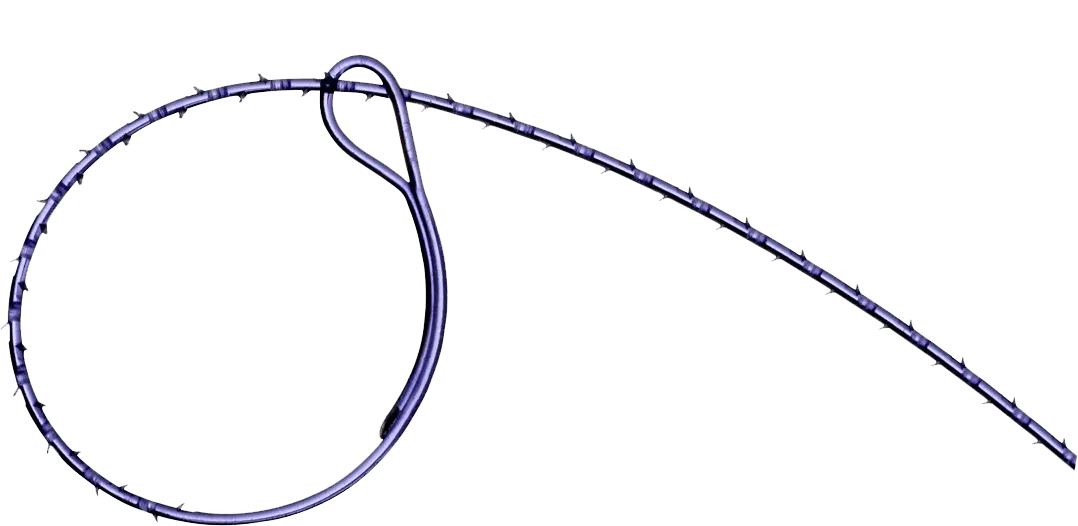
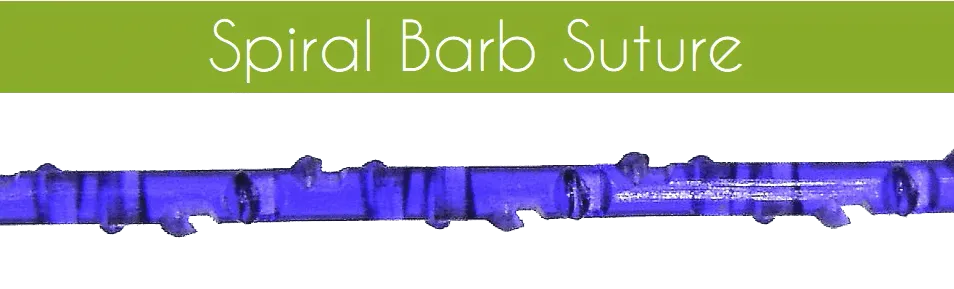
A barb is a small projection cut or moulded into the surface of a monofilament strand and angled backwards along it. That angle is the whole of the mechanism. As the strand is advanced through tissue, the barbs lie flat against it and the strand passes. If the strand is drawn the other way, the barbs lift and engage the tissue, and the strand resists moving. The suture is therefore held in place by the barbs themselves rather than by a knot tied at the end.
This is a mechanical description and it stops there. It says where the anchoring comes from, not what the resulting closure does. A conventional suture puts the whole retention of the line into two knots; a barbed suture distributes the engagement across many points along the strand. Those are different arrangements, and which one is appropriate for a given procedure is a clinical judgement governed by the product’s instructions for use.
Unidirectional and bidirectional
Barbed sutures are made in two configurations, and the difference is simply which way the barbs point.
In a unidirectional suture, every barb along the strand is angled the same way. The strand resists movement in one direction only, so it must be anchored at its starting end — commonly by a fixed loop through which the needle is passed to set the first bite. Placement then runs from that anchor.
In a bidirectional suture, the barbs are cut in opposing directions on either side of an unbarbed midpoint called the transition point. Each half resists movement toward the middle. The strand is continuous through the transition point — it is an origin, not a joint — and because each half anchors against the other, no end anchor is required. Placement runs outward from the middle in both directions.
Barb geometry, spacing and pattern vary between products, including spiral arrangements and strands supplied with or without a loop. These are construction details specified per product.
The base material still decides most of it
Barbs are cut into a monofilament, and the polymer underneath is where the material properties live. Barbed sutures are produced from monofilament materials such as polydioxanone, poliglecaprone and polypropylene — which means a barbed suture may be absorbable or non-absorbable depending entirely on what it was cut from. Polydioxanone and poliglecaprone are absorbed by hydrolysis; polypropylene is not absorbed at all.
The barbs do not alter that. They change how the strand is retained in tissue, not how the polymer behaves over time. So reading a barbed suture means reading two things separately: the configuration, which is about placement and anchoring, and the material, whose strength-retention and absorption profile is stated in its own instructions for use.
Braided sutures are not barbed. A barb needs a continuous strand surface to be cut into, and a braid — many fine filaments worked together — does not offer one without disturbing the construction it depends on.
– Read more about barbed sutures manufactured by Dolphin Sutures.
Key terminology
- Barb
- A small projection cut or moulded into the surface of a monofilament strand, angled backwards along it. Because the barb is angled, it lies flat as the strand advances and lifts to engage tissue if the strand is drawn back.
- Knotless anchoring
- Holding a strand in position by the engagement of its barbs with tissue rather than by a tied knot. A mechanical description of how the strand is retained; it says nothing about the closure that results.
- Unidirectional
- A configuration in which every barb is angled the same way along the strand, so the suture resists movement in one direction only. Such sutures are anchored at one end, commonly by a fixed loop.
- Bidirectional
- A configuration in which barbs are cut in opposing directions on either side of a central transition point, so each half resists movement toward that midpoint. It is placed from the middle outward and needs no end anchor.
- Transition point
- The unbarbed midpoint of a bidirectional strand where the barb direction reverses. It is the origin of the placement, not a joint — the strand is continuous through it.
- Monofilament
- A strand drawn as a single filament rather than braided from many. Barbs are cut into monofilaments; a braid has no continuous surface to cut a barb into without disturbing the construction.
Technical characteristics
- Construction
- Monofilament with barbs cut or moulded into the surface
- Base materials
- Barbed sutures are produced from monofilament polymers — for example polydioxanone, poliglecaprone and polypropylene
- Barb configuration
- Unidirectional or bidirectional; barb geometry, spacing and pattern vary by product
- End treatment
- Unidirectional strands are anchored at one end, commonly with a fixed loop; bidirectional strands require no end anchor
- Absorption mechanism
- Inherited from the base polymer — hydrolysis for absorbable monofilaments such as polydioxanone and poliglecaprone; polypropylene is non-absorbable
- Strength retention & absorption period
- Stated in the instructions for use supplied with the product — these are product-specific and are not reproduced here.
- Indications
- Stated in the instructions for use, together with the contraindications, warnings and precautions specific to barbed construction.
- Standards
- Manufactured to meet the pharmacopoeial requirements applicable to the base suture material
How it compares
| Suture type | Construction | Anchoring | Barb direction |
|---|---|---|---|
| Unidirectional barbed | Monofilament with barbs | Barbs engage tissue; one end anchored, commonly by a fixed loop | All barbs angled the same way along the strand |
| Bidirectional barbed | Monofilament with barbs | Barbs engage tissue; no end anchor required | Opposing on either side of an unbarbed transition point |
| Conventional monofilament | Monofilament, smooth surface | Tied knot at each end of the line | Not applicable |
| Conventional braided | Braided multifilament, coated | Tied knot at each end of the line | Not applicable |
What clinicians weigh when selecting
Where the anchoring load sits
A knotted line is held at its ends; a barbed line is held along its length. The relevant question is what that relocation means for the specific closure being planned, and it is a question about the case rather than about the strand.
The barb is cut into the strand
Barbing is a modification of a monofilament's surface. The trade-off it raises is between the anchoring the barbs provide and the change the cutting makes to the strand's cross-section — which is why barb geometry and the base material are specified together in the instructions for use.
Directionality constrains placement
A barbed strand resists movement in one direction and advances in the other. That constraint is inherent to the geometry, so the placement follows from the configuration — unidirectional from an anchored end, bidirectional from the transition point outward.
The cut end
A barbed strand terminates without a knot, so the handling of the free end is a distinct step rather than a consequence of tying off. The warnings and precautions for the end of the strand are stated in the product's instructions for use.
Base material governs the rest
Absorption mechanism, strength retention and tissue behaviour belong to the polymer the barbs were cut into, not to the barbs. The material question and the configuration question are separate, and both must be answered.
Regulatory status in your market
Approved indications for barbed sutures differ by market. The instructions for use supplied with the product in your country is the governing document.
Frequently asked questions
What is a barbed suture?
A monofilament suture with small barbs cut into its surface along the strand. The barbs engage tissue as the strand passes through, anchoring it mechanically so that it holds position without a knot being tied.
Why does a barbed suture not need a knot?
Because the anchoring is mechanical rather than tied. Each barb is angled backwards along the strand, so it lies flat as the strand advances and lifts to engage tissue if the strand is drawn back. The engagement of the barbs is what retains the strand.
What is the difference between unidirectional and bidirectional?
In a unidirectional suture every barb is angled the same way, so the strand resists movement in one direction and is anchored at one end, commonly by a fixed loop. A bidirectional suture has barbs cut in opposing directions on either side of an unbarbed transition point, is placed from that midpoint outward, and needs no end anchor.
Are barbed sutures absorbable?
That depends entirely on the base material. Barbs are cut into monofilament polymers — polydioxanone and poliglecaprone are absorbable, polypropylene is not. The barbs do not change the absorption mechanism of the polymer.
Why are barbed sutures only monofilament?
A barb is cut or moulded into a continuous strand surface. A braided suture is built from many fine filaments and has no such continuous surface to cut into without disturbing the construction.
What procedures are barbed sutures indicated for?
The approved indications, and the tissue types a product is not indicated for, are stated in the instructions for use supplied with the product. Indications for barbed sutures vary by market and we do not reproduce them here.
Instructions for use
The instructions for use supplied with the product is the controlled document for indications, contraindications, strength-retention and absorption data, and for the warnings and precautions specific to barbed construction and to the handling of the cut end. Where this article and the instructions for use differ, the instructions for use govern. Approved indications vary by market.
Medical & regulatory notice
This article is general reference information about a suture construction for healthcare professionals. It is not medical advice, not a recommendation for any procedure or patient, and not a substitute for the instructions for use supplied with the product or for clinical judgement. Product availability and approved indications vary by market. Dolphin Sutures manufactures surgical sutures; nothing here should be read as a claim of clinical benefit or of superiority over another material or technique.