
 English
 Español
 Français
 Português
 Русский
 العربية
 Deutsch
 Türkçe
 Bahasa Indonesia
 Tiếng Việt
 ไทย
ไทย 简体中文
简体中文
Plain vs chromic catgut: what chromicisation changes
Plain and chromic catgut are two forms of one natural absorbable suture material — purified collagen taken from intestinal submucosa and twisted into a strand. Chromic catgut is treated with a chromium salt solution, which changes how the collagen resists enzymatic breakdown and turns the strand dark brown.
Why it matters
Plain and chromic are routinely discussed as two materials, and they are not. They share an origin, a composition, a twisted construction and an enzymatic absorption route; one processing step separates them. Knowing that chromicisation acts on the substrate rather than on the mechanism is what tells a clinician which part of the behaviour the treatment can move and which part still belongs to the patient's own proteolytic response — and it is why the two forms carry separate instructions for use rather than one document with two columns.
One material, one process step
Plain and chromic catgut arrive in theatre as two products, and they are usually described as two materials. They are not. Both are purified collagen taken from the intestinal submucosa of sheep or goat, and both are twisted rather than braided or extruded. Origin, composition and construction are common to the two. One processing step separates them: chromic catgut is treated with a chromium salt solution, and plain catgut is not.
That framing sets the limits on what the difference can be. A treatment applied to a material can change how that material behaves; it cannot make it a different material. Everything that follows from collagen being collagen — that it is a protein, that it is therefore a substrate for enzymes, that it is animal-derived and carries the market-access questions natural-origin materials carry — is true of the chromic form exactly as it is of the plain one.
Treated, not coated
The most useful way to hold the distinction is to notice what it is not. A coating is a layer applied to a finished strand: braided synthetic absorbables are coated because braiding many filaments together creates surface texture, and the coating sits on the outside of the braid addressing that texture. Neither form of catgut is coated. Plain catgut is supplied uncoated, and chromic catgut is treated — the chromium salt solution acts on the collagen itself, cross-linking the protein chains, rather than depositing anything on the surface.
Cross-linking is the mechanism worth understanding here. Chemical bridges between adjacent collagen chains change how readily the protein presents itself to a proteolytic enzyme. The strand is still collagen and it is still digested by enzymes; what has changed is the substrate’s resistance to that digestion, from inside the material rather than at its boundary.
The colour follows from the same fact. Chromic catgut’s dark brown is a consequence of the treatment, not a dye chosen to distinguish it on a shelf — which is the more common arrangement, since synthetic sutures are routinely offered dyed and undyed. Plain catgut is ivory because nothing has been applied to it. On catgut, the colour is evidence of the process.
What the treatment leaves untouched
Chromicisation moves the substrate. It does not move the mechanism. Both forms are broken down by the body’s proteolytic enzymes, and neither is broken down by hydrolysis, which is the route for every synthetic absorbable in general use. This is where the comparison is most often overstated: a treatment that changes how collagen resists enzymatic attack does not convert catgut into a material whose behaviour is fully specified by the manufacturer, because the enzymes doing the work are still the patient’s.
That is why absorption behaviour varies, and why it varies for the chromic form as well as the plain one. It is a statement about mechanism rather than about performance, and it is the honest reason for not publishing a general figure — the timing belongs partly to the case. The strength-retention and absorption data for each product, and its tissue response, are in the instructions for use supplied with it, separately for each form, because these are separately specified products rather than two readings of one specification.
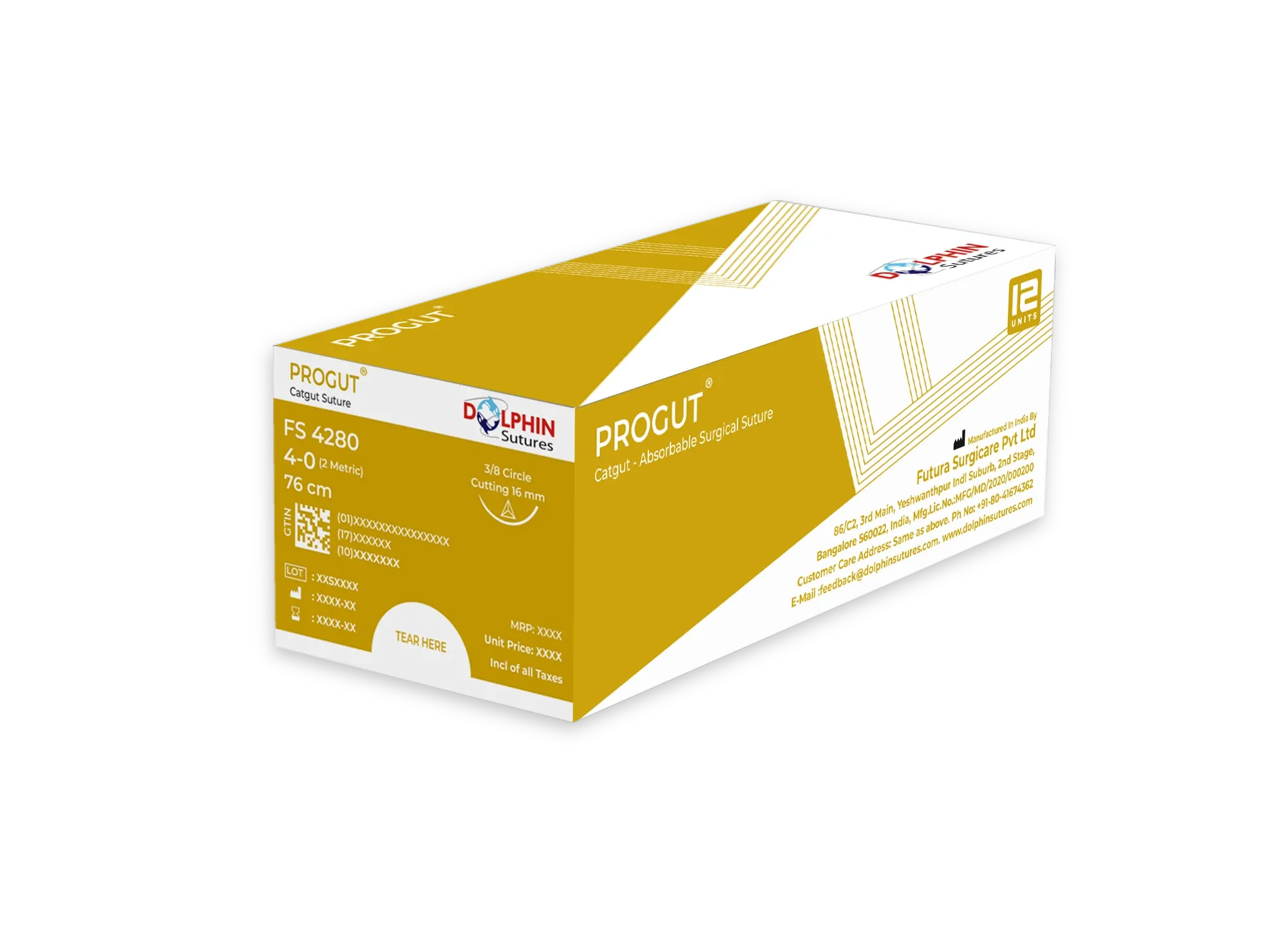
Dolphin Sutures manufactures both, as Progut Plain and Progut Chromic.
– Read more about plain catgut and chromic catgut manufactured by Dolphin Sutures
Key terminology
- Chromicisation
- Treatment of the collagen strand with a chromium salt solution. It is the single processing step that separates chromic catgut from plain catgut, and it is what gives the chromic form its dark brown colour.
- Collagen
- The structural protein the strand is made of, taken from the intestinal submucosa. Being a protein rather than a synthetic polyester is what makes it a substrate for enzymes, and that is true of both forms equally.
- Cross-linking
- The formation of chemical bridges between adjacent protein chains. It changes how the existing collagen behaves as a substrate; it does not replace it with a different material.
- Enzymatic (proteolytic) absorption
- Breakdown of a protein by the body's own enzymes. It is the absorption route for plain and chromic catgut alike, and chromicisation does not change it.
- Twisted construction
- Strands laid together by twisting rather than braided or extruded. Both forms of catgut share it, so construction is not what distinguishes them from each other.
- Treated against coated
- A coating is a layer applied to a finished strand and sits on its surface. Chromicisation is a treatment of the collagen itself. Neither plain nor chromic catgut is coated.
Technical characteristics
- Base material (both forms)
- Purified collagen from the intestinal submucosa of sheep (ovine) or goat
- Construction (both forms)
- Twisted strand — neither form is braided or extruded
- Absorption mechanism (both forms)
- Enzymatic (proteolytic). Chromicisation does not change the route by which the strand is broken down
- Plain catgut
- Uncoated and not chromic-treated; ivory in colour
- Chromic catgut
- Treated with a chromium salt solution; dark brown in colour. Purified collagen at approximately 99% w/w of the suture material
- Nature of the treatment
- A treatment of the collagen itself, not a coating applied to a finished strand. Neither form is coated
- Strength retention & absorption period
- Stated in the instructions for use supplied with the product — these are product-specific, differ between the plain and the chromic form, and are not reproduced here.
- Tissue response
- Stated in the instructions for use supplied with the product — product-specific and not reproduced here.
- Indications
- Stated in the instructions for use. Catgut is not indicated for every tissue type, and the two forms are approved separately; the IFU specifies the exclusions.
- Dolphin brands
- Progut Plain (plain catgut) and Progut Chromic (chromic catgut)
- Standards
- Manufactured to meet the USP and EP requirements for absorbable surgical sutures
How it compares
| Material | Base material | Construction | Treatment or coating | Absorption mechanism |
|---|---|---|---|---|
| Plain catgut | Natural — purified collagen | Twisted | None; uncoated and untreated | Enzymatic (proteolytic) |
| Chromic catgut | Natural — purified collagen | Twisted | Chromium salt solution, applied to the collagen rather than as a surface layer | Enzymatic (proteolytic) |
| PGA | Synthetic — 100% glycolide | Braided multifilament | Coating applied to the finished braid | Hydrolysis |
What clinicians weigh when selecting
One material, two specifications
The two forms share a base material, an origin and a construction, but they are separately specified products. The relevant question when a figure is needed is not what catgut does, but which of the two instructions for use is in front of you.
What the treatment moves, and what it does not
Cross-linking acts on the collagen substrate; it does not change the route by which the body breaks the strand down. The trade-off to reason about is that absorption remains an enzymatic process in both forms, so it stays coupled to the patient's own proteolytic activity either way.
Treatment against coating
On a braided synthetic, uncoated describes a missing surface layer. On catgut, neither form carries a coating at all, and the chromic distinction sits inside the strand rather than on it. The question is whether the mental model carried over from synthetics still applies here.
What the colour does and does not tell you
Chromic catgut's dark brown follows from the treatment rather than from a dye added for identification, and plain catgut is ivory for the same reason — nothing was applied to it. Colour identifies which form is in the pack; it is not a reading of anything beyond that.
Two separately approved products
Natural-origin materials are not uniformly available across markets, and the plain and chromic forms are approved separately. The question before either is specified is which form is approved and supplied where the procedure takes place.
Frequently asked questions
Are plain and chromic catgut different materials?
No. They are the same material in two forms — purified collagen taken from intestinal submucosa and twisted into a strand. Chromic catgut has been treated with a chromium salt solution and plain catgut has not. That is a processing step applied to the same base material, not a substitution of one material for another.
What does chromicisation actually do to the strand?
It cross-links the collagen, forming chemical bridges between the protein chains, which changes how the strand resists enzymatic attack. It acts on the collagen itself rather than depositing a layer on the outside. What that means for a given product is stated in its instructions for use.
Does chromic treatment change how catgut is absorbed?
It does not change the mechanism. Both forms are broken down by the body's proteolytic enzymes rather than by hydrolysis. What the treatment changes is how the collagen resists that attack. Because the mechanism is enzymatic in both forms, absorption behaviour is coupled to the patient's own inflammatory and enzymatic response and varies accordingly; the figures for each product are in its instructions for use.
How long does each form take to absorb?
The absorption period is product-specific and is stated in the instructions for use supplied with the product, separately for the plain and the chromic form. We do not publish absorption figures outside that document, because the IFU is the controlled source and because this is a mechanism whose timing varies with the patient.
Why is chromic catgut dark brown and plain catgut ivory?
The colour is a consequence of the chromic treatment, not a dye added to tell the two apart. Plain catgut is ivory because nothing has been applied to it; it is supplied uncoated.
Is either form coated?
No. Plain catgut is uncoated, and chromic catgut is treated rather than coated — the chromium salt solution acts on the collagen instead of forming a surface layer. This differs from braided synthetic absorbables, which are coated because braiding creates surface texture.
Instructions for use
The instructions for use supplied with the product is the controlled document for indications, contraindications, strength-retention and absorption data, tissue response, warnings and precautions. Plain and chromic catgut are separately specified products with their own instructions for use, and a figure read from one does not describe the other. Where this article and the instructions for use differ, the instructions for use govern. Approved indications vary by market.
Medical & regulatory notice
This article is general reference information about a suture material for healthcare professionals. It is not medical advice, not a recommendation for any procedure or patient, and not a substitute for the instructions for use supplied with the product or for clinical judgement. Product availability and approved indications vary by market. Dolphin Sutures manufactures surgical sutures; nothing here should be read as a claim of clinical benefit, or of the superiority of either form of catgut over the other or over any other material.