
 English
 Español
 Français
 Português
 Русский
 العربية
 Deutsch
 Türkçe
 Bahasa Indonesia
 Tiếng Việt
 ไทย
ไทย 简体中文
简体中文
Polydioxanone (PDS) Sutures
Polydioxanone (PDS) is a synthetic absorbable suture material made from poly(p-dioxanone), a colourless crystalline polymer, extruded as a monofilament. It is the only suture material in common use built from p-dioxanone, and like all synthetic absorbables it is broken down by hydrolysis.
Why it matters
The other synthetic absorbables are built from glycolide, lactide and caprolactone in various combinations — they are pure polyesters, and they are variations on one theme. Polydioxanone is not: its chain carries an ether oxygen as well as an ester linkage, which makes it a poly(ether-ester) rather than a polyester. That is a genuine chemical distinction, and it is why the material is not simply another point on the same scale.
A poly(ether-ester), not another polyester
Polydioxanone is the odd one out among the synthetic absorbables, and the reason is in the backbone.
PGA, polyglactin 910 and poliglecaprone are all built from cyclic esters — glycolide, lactide, caprolactone — mixed in different proportions. They are pure polyesters, and however different their profiles, they are variations on one chain chemistry. Polydioxanone is built from p-dioxanone, a single monomer that contributes both an ester linkage and an ether oxygen to the chain. The polymer is therefore a poly(ether-ester), and it is a homopolymer rather than a copolymer: there is no second monomer being blended in to adjust it.
The absorption mechanism is unaffected by this. Hydrolysis acts at the ester linkages, as it does in every synthetic absorbable — water reaches the backbone, the chains shorten, tensile strength goes first and mass afterwards, and the two events are stated as two separate figures in the instructions for use for exactly that reason. What the ether oxygen changes is the character of the chain itself, and that is a chemical distinction rather than a performance ranking. The practical consequence for anyone reading specifications is narrow but real: polydioxanone is not a longer-lasting version of the glycolide materials, it is a different material, and its numbers come from its own document.
Construction, and a manufacturing constraint
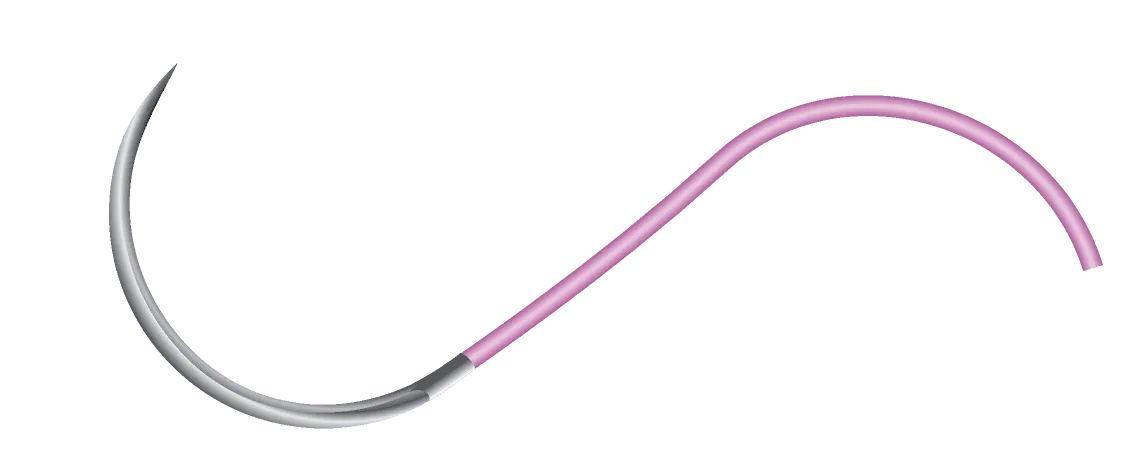
The strand is a monofilament — a single filament extruded from the polymer, with no filaments laid together and no interstices between them. The structural consequences follow directly and are worth stating as structure rather than as benefit: capillarity does not arise, because there are no interstices for fluid to travel along; there is no braid surface, so the material is supplied uncoated, a coating being the response to braiding rather than an addition to it. Memory is a handling property of monofilaments generally, and how a given strand handles belongs to the surgeon’s technique rather than to a specification.
Extruding the fibre is where the chemistry asserts itself again. Polydioxanone is prone to depolymerisation — reverting to p-dioxanone monomer — at elevated temperature, so the polymer is processed at the lowest practical temperature. This is a manufacturing constraint arising directly from the polymer’s own chemistry, and it is one of the more distinctive facts about the material class.
Dolphin Sutures manufactures polydioxanone under the brand name Duracryl. PDS is another manufacturer’s brand of the same generic material; the pharmacopoeias and the instructions for use use the generic name.
– Read more about polydioxanone sutures manufactured by Dolphin Sutures
Key terminology
- p-Dioxanone
- The cyclic monomer polydioxanone is built from. It is the sole constituent of the polymer, which makes polydioxanone a homopolymer rather than a copolymer.
- Poly(ether-ester)
- A polymer whose backbone contains both ether and ester linkages. Polydioxanone is one; the glycolide, lactide and caprolactone materials are pure polyesters.
- Ether oxygen
- An oxygen atom joining two carbon chains without a carbonyl group. Its presence in the polydioxanone backbone is what distinguishes the chain chemistry from the other synthetic absorbables.
- Monofilament
- A single extruded strand rather than many filaments laid together. It has no interstices and therefore no capillarity.
- Hydrolysis
- Breakdown of the polymer by reaction with water at the ester linkages. It proceeds by loss of tensile strength first, then loss of mass, and is the absorption mechanism for all synthetic absorbable sutures.
- Depolymerisation
- The reversion of a polymer to its monomer. Polydioxanone is prone to it at elevated temperature, which constrains how the fibre can be extruded.
- Memory
- A strand's tendency to return to the shape it was packaged in. It is a handling property associated with monofilament construction rather than with braids.
Technical characteristics
- Composition
- Poly(p-dioxanone) — a homopolymer of p-dioxanone
- Polymer class
- Poly(ether-ester); the polymer itself is colourless and crystalline
- Construction
- Monofilament (extruded single strand)
- Coating
- None — coating addresses braid construction, and this material is not braided
- Absorption mechanism
- Hydrolysis — loss of tensile strength precedes loss of mass
- Colour
- Commonly supplied dyed (blue); availability is product-specific
- Capillarity
- Not applicable — a monofilament has no interstices
- Dolphin brand
- Duracryl
- Strength retention & absorption period
- Stated in the instructions for use supplied with the product — these are product-specific and are not reproduced here.
- Indications
- Stated in the instructions for use. Polydioxanone is not indicated for every tissue type; the IFU specifies the exclusions.
- Standards
- Manufactured to meet the USP and EP requirements for synthetic absorbable surgical sutures
How it compares
| Material | Origin | Construction | Absorption mechanism |
|---|---|---|---|
| Polydioxanone | Synthetic (p-dioxanone homopolymer) | Monofilament | Hydrolysis |
| Poliglecaprone | Synthetic (glycolide/caprolactone copolymer) | Monofilament | Hydrolysis |
| PGA | Synthetic (100% glycolide) | Braided multifilament | Hydrolysis |
| Polyglactin 910 | Synthetic (glycolide/L-lactide copolymer) | Braided multifilament | Hydrolysis |
| Catgut | Natural (purified collagen) | Twisted | Enzymatic (proteolytic) |
What clinicians weigh when selecting
Absorption profile against healing time
The relevant question is how long the tissue needs support, read against the strength-retention profile in the product's instructions for use. A material that outlasts the need is not automatically the safer choice, and the two figures are not one.
A different chain chemistry, not a longer version of the same one
Polydioxanone is a poly(ether-ester) where the other synthetic absorbables are polyesters. The relevant question is whether you are reasoning from this material's own instructions for use rather than extrapolating along a scale the material is not on.
Monofilament against braided
A monofilament has no interstices and no capillarity; a braid is pliable and seats a knot readily. Both properties are real and they point in different directions depending on the field.
Handling and memory
Memory is a handling property of monofilament construction generally. How a given strand handles is a matter of surgeon technique and preference rather than a specification.
Regulatory status in your market
Approved indications differ by market. The instructions for use supplied with the product in your country is the governing document.
Frequently asked questions
What is polydioxanone made of?
Poly(p-dioxanone) — a homopolymer built from the single cyclic monomer p-dioxanone. Unlike polyglactin 910 and poliglecaprone, it is not a copolymer, and unlike any of the glycolide-based materials it is a poly(ether-ester) rather than a pure polyester.
What does the ether oxygen in the backbone do?
It sits between carbon chains without a carbonyl group, and it is the structural feature that separates polydioxanone's chain chemistry from the glycolide, lactide and caprolactone materials. Hydrolysis still acts at the ester linkages; the ether oxygen is not itself the cleavage point.
Is polydioxanone the same as PDS?
PDS is a brand name for polydioxanone suture. Dolphin Sutures manufactures polydioxanone under the brand name Duracryl. The generic material name is what the pharmacopoeias and the IFU use.
How long does polydioxanone take to absorb?
The absorption period is product-specific and is stated in the instructions for use supplied with the product. We do not publish absorption figures outside that document, because the IFU is the controlled source.
Is polydioxanone suture coated?
No. A coating addresses the drag and surface texture that come from braiding. A monofilament has no interstices and no braid surface, so there is nothing for a coating to address.
Why must polydioxanone be extruded carefully?
The polymer is prone to depolymerising — reverting to its monomer — at elevated temperature, so the fibre is processed at the lowest practical temperature. It is a manufacturing constraint arising from the polymer's chemistry.
Instructions for use
The instructions for use supplied with the product is the controlled document for indications, contraindications, strength-retention and absorption data, warnings and precautions. Where this article and the instructions for use differ, the instructions for use govern. Approved indications vary by market.
Medical & regulatory notice
This article is general reference information about a suture material for healthcare professionals. It is not medical advice, not a recommendation for any procedure or patient, and not a substitute for the instructions for use supplied with the product or for clinical judgement. Product availability and approved indications vary by market. Dolphin Sutures manufactures surgical sutures; nothing here should be read as a claim of clinical benefit or of superiority over another material.