
 English
 Español
 Français
 Português
 Русский
 العربية
 Deutsch
 Türkçe
 Bahasa Indonesia
 Tiếng Việt
 ไทย
ไทย 简体中文
简体中文
Polyamide (Nylon) Sutures
Polyamide, commonly called nylon, is a synthetic non-absorbable suture material built from repeating units joined by amide bonds. Suture-grade nylon is usually polymerised from caprolactam and extruded as a monofilament. It is classed non-absorbable, though the amide bond does hydrolyse slowly in tissue.
Why it matters
Polyamide is the clearest illustration of what the non-absorbable classification does and does not assert. Its backbone contains amide bonds, and an amide bond is hydrolysable — so nylon does slowly react with water in tissue, over a timescale quite unlike that of an absorbable suture. It is still classed non-absorbable, because the classification turns on whether the body metabolises the material as part of its normal chemistry, not on whether the material is eternally unchanged. Reading the category as "inert forever" is a misreading; reading it as "not metabolised" is exact, and it is what lets a clinician reason about the material honestly.
How nylon is made
Polyamide is a macromolecule whose repeating units are joined by amide bonds — the same linkage, chemically, that joins one amino acid to the next in a protein. Suture-grade nylon is commonly Nylon 6, and the route to it is ring-opening polymerisation: caprolactam, a cyclic amide, has its ring broken under heat in an inert atmosphere, and the opened units link into long chains. The molten polymer is then extruded through a spinneret to draw it into filaments.
The name carries the chemistry. Caprolactam’s ring contains six carbon atoms, so the polymer made from it is Nylon 6. Other nylons — polymerised from different monomers, or from monomer pairs — are numbered on the same principle, and the numbers are counting carbons rather than grading anything.
The interesting part: non-absorbable, but not unchanging
Here is the nuance that makes polyamide worth reading carefully. An amide bond is hydrolysable — water can cleave it. That is not a marginal claim about nylon; it is the same reason the peptide bonds in a protein can be broken down. And in tissue, over long periods, nylon’s amide bonds do slowly hydrolyse. The material is not chemically frozen in place.
Yet polyamide is classed non-absorbable, and correctly so. The classification asks whether the body breaks the material down and metabolises it as part of its normal chemistry — the way it handles an absorbable suture, on a timescale measured against wound healing. Nylon is not handled that way. The slow hydrolysis of its amide bonds is a fact of the polymer’s chemistry operating over a quite different timescale, and it does not make the material absorbable in the sense the category means.
The lesson generalises across this cluster. “Non-absorbable” is a statement about metabolism, not a promise of permanence. Silk is the other member of the class that makes the same point from a different direction. Polypropylene, whose backbone is a pure hydrocarbon chain with no hydrolysable bond in it at all, is the contrast case. All three sit in the same category, and their chemistry is not the same — which is exactly why the category is a starting point for reasoning rather than the end of it, and why what a given product does over time is stated in its instructions for use rather than inferred from its class.
Construction and colour
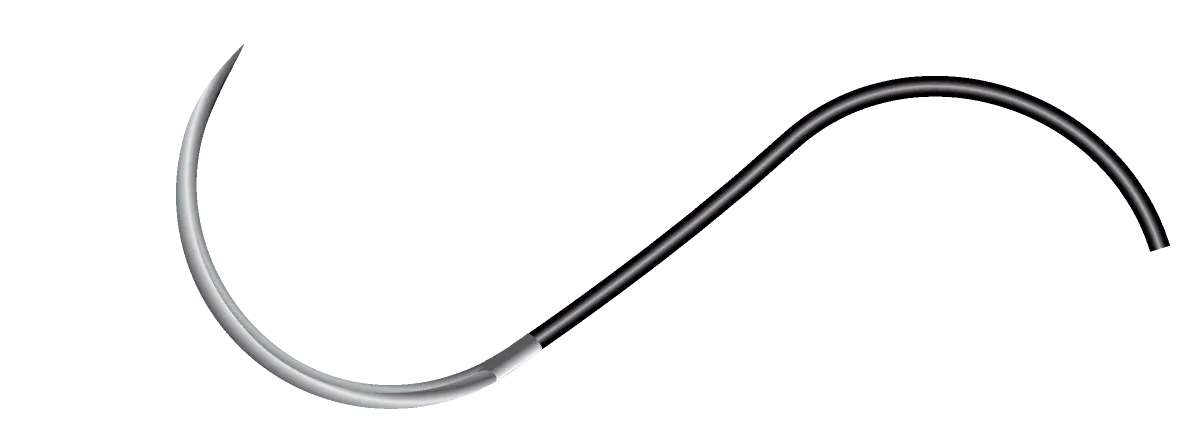
Polyamide suture is commonly extruded as a monofilament: one continuous filament, no interstices between filaments, and so no capillarity. Braided polyamide exists too, and the trade-offs there are the ones braid construction always brings — pliability and knot seating on one side, interstices and surface texture on the other.
As a monofilament, nylon carries memory: it holds the shape of the pack and has to be worked out of it. It is commonly supplied dyed black, which is an identification and visibility aid and has no bearing on how the material behaves. Colour and gauge availability are product-specific; the product page lists what is offered.
Key terminology
- Polyamide
- A macromolecule whose repeating units are joined by amide bonds — the same linkage that joins amino acids in a protein. Nylon is the common synthetic family.
- Caprolactam
- A cyclic amide with a six-carbon ring. It is the monomer from which Nylon 6 is made; the six carbons are what the "6" in the name counts.
- Ring-opening polymerisation
- A polymerisation in which a cyclic monomer's ring is broken and the resulting units link into a chain. It is how caprolactam becomes Nylon 6.
- Spinneret
- A die with fine orifices through which molten polymer is extruded to form filaments. It is the step that turns bulk nylon into a fibre.
- Monofilament
- A strand extruded as a single continuous filament. It has no interstices between filaments and therefore no capillarity.
- Memory
- A strand's tendency to return to the shape it was packaged in. It is a property of the polymer and of the extrusion.
- USP
- United States Pharmacopeia. Sets the gauge and tensile-strength requirements a suture must meet at each size. The European Pharmacopoeia (EP) sets a parallel standard.
Technical characteristics
- Composition
- Synthetic polyamide — repeating units joined by amide bonds. Suture-grade nylon is commonly Nylon 6, polymerised from caprolactam.
- Construction
- Monofilament; braided multifilament forms also exist
- Absorption classification
- Non-absorbable — not metabolised by the body
- Behaviour in tissue
- The amide bond hydrolyses slowly in vivo, so the material is not chemically unchanging despite its classification. The rate and its consequences for any product are stated in that product's instructions for use.
- Capillarity
- None in monofilament form — a consequence of the construction
- Colour
- Commonly available dyed black
- Strength retention & duration in tissue
- Stated in the instructions for use supplied with the product — these are product-specific and are not reproduced here.
- Indications
- Stated in the instructions for use. Polyamide is not indicated for every tissue type; the IFU specifies the exclusions.
- Standards
- Manufactured to meet the USP and EP requirements for non-absorbable surgical sutures
How it compares
| Material | Origin | Construction | Backbone chemistry |
|---|---|---|---|
| Polyamide (nylon) | Synthetic (polyamide) | Monofilament and braided forms | Amide bonds; hydrolyse slowly in vivo |
| Polypropylene | Synthetic (linear polyolefin) | Monofilament | Carbon–carbon chain; no hydrolysable bond |
| Polyester (PET) | Synthetic (polyethylene terephthalate) | Braided multifilament, commonly coated | Ester bonds in an aromatic chain |
| Silk | Natural (processed protein fibre) | Braided multifilament | Peptide bonds (fibroin protein) |
| Stainless steel | Metallic (316L alloy) | Monofilament and multifilament forms | Not a polymer — metallic |
What clinicians weigh when selecting
A non-absorbable material that still changes
Polyamide is classed non-absorbable and its amide bonds nonetheless hydrolyse slowly in tissue. The relevant question for a permanent implant is not which category the material falls in but what the product's instructions for use state about its behaviour over time.
Monofilament construction
A monofilament has no interstices and no capillarity, and carries a smooth surface through tissue. Whether those are the properties that matter is a question about the field, not about the spool.
Handling and memory
Polyamide carries memory, as monofilaments generally do. How a strand's stiffness bears on knotting technique is a matter of surgeon preference and training rather than a ranking of materials.
Removal against permanent implantation
The relevant question is whether this strand comes out after healing or stays. The material serves both, and the slow hydrolysis above is worth weighing only in the second case.
Gauge and needle
USP size governs the strength the strand is required to meet. Needle geometry is selected against the tissue rather than the suture material.
Regulatory status in your market
Approved indications differ by market. The instructions for use supplied with the product in your country is the governing document.
Frequently asked questions
Is nylon the same as polyamide?
Yes, in this context. Polyamide is the chemical class — macromolecules joined by amide bonds — and nylon is the common name for the synthetic polyamides. Suture-grade nylon is commonly Nylon 6.
Why is it called Nylon 6?
Because it is polymerised from caprolactam, a cyclic amide whose ring contains six carbon atoms. The number counts the carbons in the monomer unit.
If polyamide hydrolyses, why is it called non-absorbable?
Because the classification turns on whether the body metabolises the material, not on whether the material is chemically unchanging. Nylon's amide bonds do react slowly with water in tissue, but the material is not broken down and metabolised the way an absorbable suture is, and it is classed accordingly.
Is polyamide suture a monofilament?
Usually. It is commonly extruded as a single continuous filament, so it has no interstices and no capillarity. Braided polyamide also exists.
How long does polyamide hold its strength?
That is product-specific and is stated in the instructions for use supplied with the product. We do not publish strength-retention figures outside that document, because the IFU is the controlled source.
Why is nylon suture black?
It is commonly supplied dyed black as an aid to identification and visibility against tissue. Colour availability is product-specific.
Instructions for use
The instructions for use supplied with the product is the controlled document for indications, contraindications, strength-retention data, warnings and precautions. Where this article and the instructions for use differ, the instructions for use govern. Approved indications vary by market.
Medical & regulatory notice
This article is general reference information about a suture material for healthcare professionals. It is not medical advice, not a recommendation for any procedure or patient, and not a substitute for the instructions for use supplied with the product or for clinical judgement. Product availability and approved indications vary by market. Dolphin Sutures manufactures surgical sutures; nothing here should be read as a claim of clinical benefit or of superiority over another material.