
 English
 Español
 Français
 Português
 Русский
 العربية
 Deutsch
 Türkçe
 Bahasa Indonesia
 Tiếng Việt
 ไทย
ไทย 简体中文
简体中文
Monofilament vs Braided Sutures: What Construction Changes
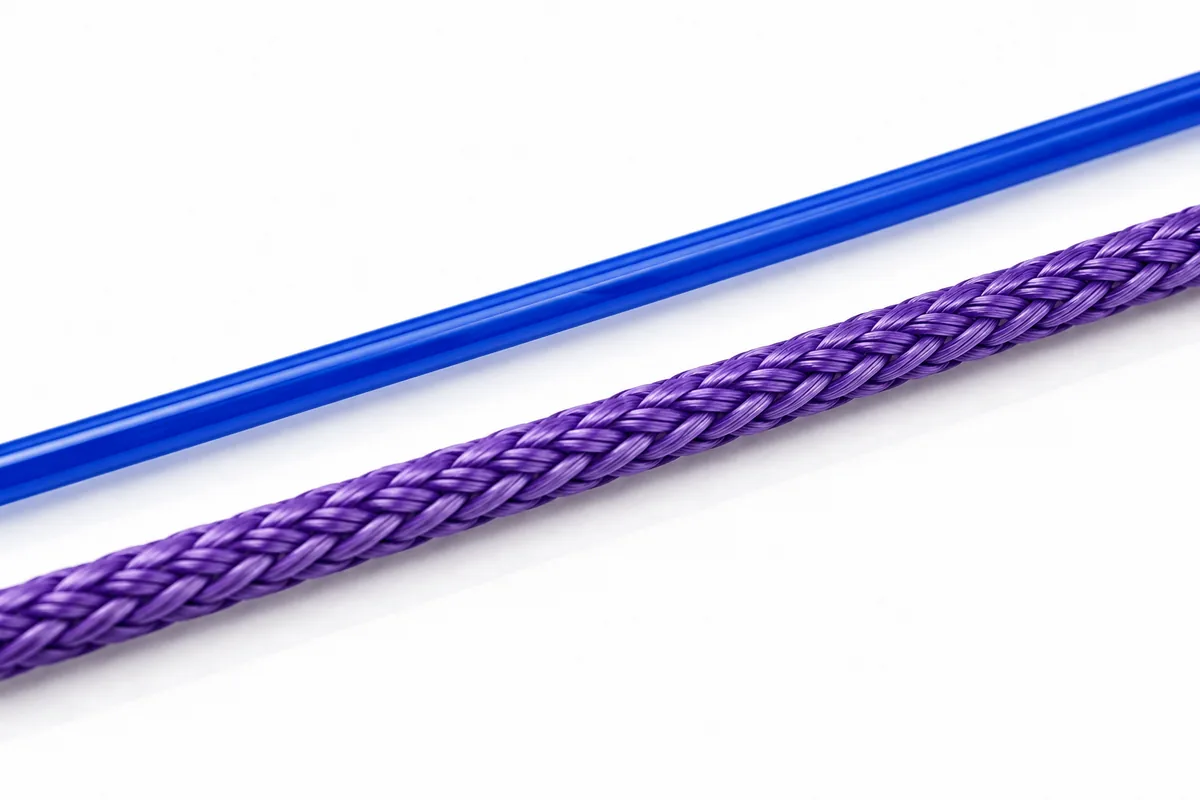
A monofilament suture is extruded as a single strand; a braided suture is many fine filaments interlaced into one. The structural difference is the spaces between those filaments — the interstices — and the properties that separate the two constructions all follow from whether they exist.
Why it matters
Construction is chosen separately from material. The same polymer can be drawn as a monofilament or braided, so "which suture" is not one decision: the material determines what becomes of the strand in tissue, the construction determines how it behaves as it gets there and what its surface does. Reading a specification means separating the two, because a property that belongs to the braid is routinely attributed to the polymer.
One difference, and what follows from it
Put the two strands end-on and the whole comparison is visible at once. A monofilament is a single circle of polymer. A braid is a bundle of small circles, and circles cannot fill a circle — there are always gaps left between them.
This figure needs WebGL. At the same overall diameter, a monofilament is one solid strand with nothing inside it, and its cut end is a single disc. A braid is many fine filaments interlaced — half wound one way around the axis and half the other, each passing alternately over and under the others — and its cut end is a ring of separate filament ends with gaps, the interstices, between them.
Those gaps are the interstices, and almost everything said about braided versus monofilament sutures traces back to them.
Capillarity belongs to the construction
A strand with interstices has a continuous route along its length, and fluid can travel it. That is capillarity, and it is the most consequential difference between the two constructions.
It is worth being precise about what this is a property of. Capillarity is not a property of polyglactin, or of silk, or of polyester. It is a property of the braid those materials are assembled into — which is why the same polymer drawn as a monofilament does not exhibit it, and why the question of whether it matters is a question about the surgical field rather than about the material.
Coating is a response, not an addition
Braided sutures are coated; monofilaments generally are not. That is not a difference in how much care the two receive. A braid has surface texture and interstices, both of which affect how the strand passes through tissue and how a knot tightens down. A coating addresses them. A monofilament has a smooth extruded surface and no interstices, so there is little for a coating to do.
This matters when reading a comparison, because a coated braid set against an uncoated monofilament differs in two variables, not one. See antibacterial coatings for what is applied and why.
Handling is a real difference and not a performance claim
Braided strands are generally more pliable and seat a knot readily. Monofilaments are generally stiffer and carry more memory — the tendency to return to the shape they were packaged in — and knots in them typically need more throws.
These are handling characteristics. They are genuine, surgeons have well-founded preferences about them, and they appear in no specification as a figure. They are not measures of performance, and a specification that quoted them would be quoting an opinion.
The material does not fix the construction
It is easy to read “monofilament” as a class of material. It is not. Polyamide, polyester and stainless steel are each supplied in both constructions. Choosing a polymer does not choose a construction; a product code states both, and they answer different questions.
Among the materials in this range, polypropylene, polydioxanone and poliglecaprone are monofilaments; polyglactin 910, PGA, silk and UHMWPE are braided. See types of sutures for how construction sits alongside the other axes a material is classified on.
Strength is set by size, not by construction
USP fixes a minimum tensile strength at each size, and both constructions must exceed the same floor. Construction does not exempt a strand from it or raise it. What construction changes is how the strand behaves in the hand and how a knot seats — which is a different question from what force breaks it. See suture strength for how that minimum is measured, and why the figure normally quoted is the knotted one.
Which to use
That is a clinical judgement about the tissue, the field and the closure, and it is not a question this page can answer. The approved indications for any given product, and the tissue types it is not indicated for, are stated in the instructions for use supplied with it.
Key terminology
- Monofilament
- A strand extruded as one continuous filament. It has no internal structure and therefore no spaces within the strand.
- Multifilament
- A strand assembled from many fine filaments. Braiding and twisting are the two ways of assembling them; braided is by far the more common in surgical suture.
- Interstices
- The spaces left between round filaments packed together. They are a consequence of geometry — filaments cannot tile a circle without gaps — and they are what a monofilament does not have.
- Capillarity
- The tendency of a strand to draw fluid along its length. It arises from the interstices, so it is a property of the construction and not of the polymer.
- Coating
- A surface layer applied to a braid to reduce drag through tissue and smooth knot tie-down. Applied to braids because a braid has the surface texture and the interstices a coating addresses.
- Knot security
- Whether a tied knot holds its position. A separate property from tensile strength, and influenced by construction, coating and technique.
- Memory
- A strand's tendency to return to its packaged shape. Generally associated with stiffer monofilaments; it is a handling characteristic, not a performance measure.
Technical characteristics
- Monofilament construction
- One extruded filament; no interstices within the strand
- Braided construction
- Many fine filaments interlaced; interstices between them
- Capillarity
- A property of multifilament construction; a monofilament has no route for fluid along the strand
- Coating
- Routinely applied to braids; a monofilament has no interstices and little surface texture for a coating to address
- Materials made both ways
- Polyamide (nylon), polyester and stainless steel are supplied in both constructions; the polymer does not fix the construction
- Monofilament materials in this range
- Polypropylene, polydioxanone, poliglecaprone 25, PTFE, PVDF, stainless steel
- Braided materials in this range
- Polyglactin 910, polyglycolic acid, polyester, silk, UHMWPE
- Strength, absorption and indications
- Product-specific and stated in the instructions for use supplied with the product — not reproduced here.
How it compares
| Property | Monofilament | Braided |
|---|---|---|
| Structure | One extruded filament | Many filaments interlaced |
| Interstices | None within the strand | Present between filaments |
| Capillarity | None along the strand | A property of the construction |
| Surface | Smooth as extruded | Textured by the braid; usually coated |
| Coating | Rarely applied | Routine, and a response to the construction |
| Typical handling | Stiffer, more memory | More pliable, lies flatter |
| Knot seating | Knots tend to require more throws | Knots seat readily |
What clinicians weigh when selecting
The field, not the material
Capillarity is a property of braid, and whether it matters is a question about the surgical field — clean, contaminated or infected — rather than about the strand on the shelf. That is a judgement about the case.
Handling against the closure
Pliability and knot seating are handling characteristics, and a surgeon's preference is a legitimate input. They are not measures of performance and are not stated as figures in a specification.
Construction is not fixed by material
Polyamide, polyester and steel are supplied both ways. Choosing a polymer does not choose a construction, and a specification states both.
Coating belongs to the braid
Where a product is coated, the coating is a response to the construction rather than an addition to the material. Comparing a coated braid with an uncoated monofilament is comparing two variables at once.
Neither is the safer default
The two constructions differ; neither is a general-purpose improvement on the other. What is appropriate for a given tissue is stated in the instructions for use, and is a clinical judgement.
Regulatory status in your market
Approved indications differ by market. The instructions for use supplied with the product in your country is the governing document.
Frequently asked questions
What is the difference between a monofilament and a braided suture?
A monofilament is extruded as one continuous strand; a braided suture is many fine filaments interlaced into one. The structural difference is the spaces between those filaments, and the properties that separate the two constructions follow from whether those spaces exist.
Which is better, monofilament or braided?
Neither. They differ, and the differences point in different directions depending on the tissue and the closure. Which is appropriate is a clinical judgement, and the approved indications for a given product are stated in its instructions for use.
Why do braided sutures have capillarity and monofilaments not?
Capillarity needs a route for fluid to travel along the strand. The interstices between braided filaments provide one; a monofilament has no internal structure, so there is nothing to wick along. This is why capillarity is described as a property of construction rather than of the polymer.
Why are braided sutures coated?
A braid has surface texture and interstices, which create drag as the strand passes through tissue and affect how a knot tightens. A coating smooths both. A monofilament presents neither, so there is little for a coating to do.
Can the same material be both?
Yes. Polyamide (nylon), polyester and stainless steel are all supplied in both constructions. The polymer and the construction are specified separately.
Does construction affect strength?
USP sets a minimum tensile strength at each size regardless of construction, so both must exceed the same floor. What differs is how the strand behaves in the hand and at the knot. See suture strength for how that minimum is measured.
Instructions for use
The instructions for use supplied with the product is the controlled document for indications, contraindications, strength-retention and absorption data, warnings and precautions. Where this article and the instructions for use differ, the instructions for use govern. Approved indications vary by market.
Medical & regulatory notice
This article is general reference information about suture construction for healthcare professionals. It is not medical advice, not a recommendation for any procedure or patient, and not a substitute for the instructions for use supplied with the product or for clinical judgement. Product availability and approved indications vary by market. Dolphin Sutures manufactures surgical sutures; nothing here should be read as a claim of clinical benefit or of superiority of one construction over the other.